Research procedure
Sample compounds along avenues
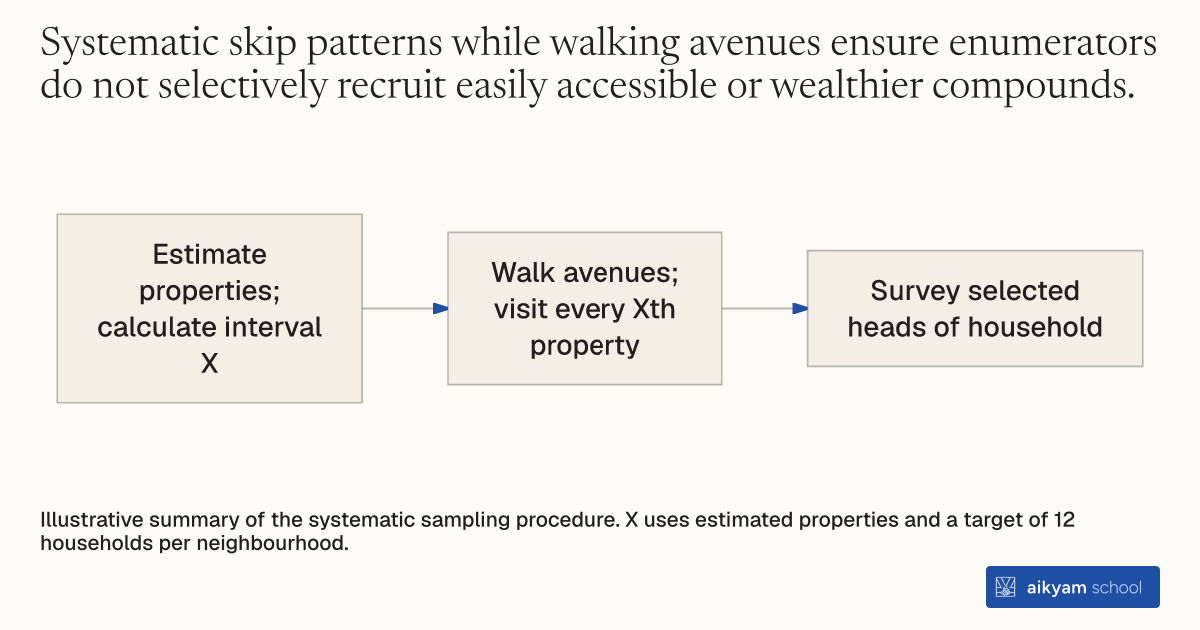
- Estimate properties; calculate interval X
- Walk avenues; visit every Xth property
- Survey selected heads of household
Illustrative summary of the systematic sampling procedure. X uses estimated properties and a target of 12 households per neighbourhood.
See source →How
When to use
In dense urban environments lacking formal household rosters or censuses, selecting a representative sample of households is challenging. Survey teams need a standardized systematic field protocol to randomize household selection across broad urban neighborhoods. By walking down each avenue and applying a calculated property skip pattern, field teams achieve unbiased representative household sampling.
Sample urban households systematically by walking each avenue within a target neighborhood and applying a fixed property skip pattern.
- Determine the target number of survey respondents per neighborhood polygon, such as 12 households per neighborhood.
- Estimate the total number of compound properties present along the avenues within the neighborhood polygon.
- Calculate the skip interval X by dividing the total estimated properties by the target respondent count.
- Instruct independent enumerators to walk down each avenue in the neighborhood, visiting every Xth property according to Section 5.
- Administer the baseline household survey to the head of household at each selected compound.
Why it works
This randomized spatial coverage produces a representative baseline sample across unmapped urban neighborhoods.
Example
Independent enumerators sampled 4,343 households across 364 neighborhoods in Kananga, DRC, targeting 12 households per neighborhood by visiting every Xth property while walking down each avenue.
About the study
Participants
4,343 randomly sampled households across 364 neighborhoods in Kananga, Democratic Republic of Congo, with 483 eligible households in the main analysis sample.
Study Design
Systematic household field sampling via avenue walking skip patterns prior to household-level randomized assignment to a subsidized land titling campaign.
Results
Program assignment caused a 44 percentage point increase in initiation of the land titling process and a 13.7 percentage point increase in actual receipt of formal land titles.