Try, learn and adjust
Check health workers are notified when transfers are sent
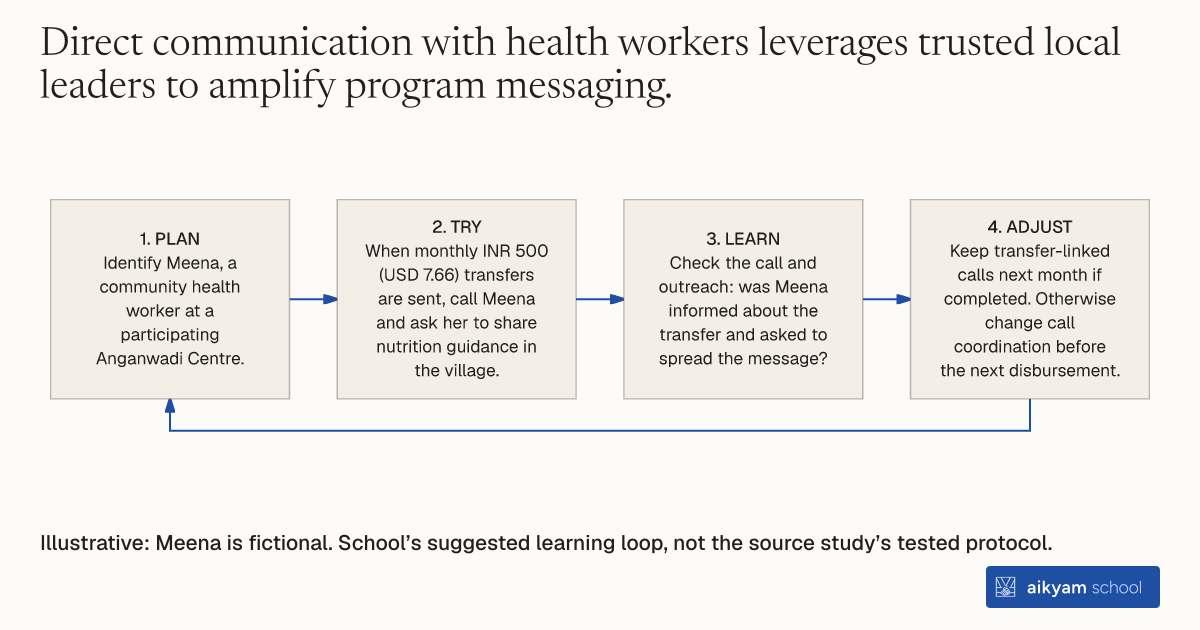
- Plan: Identify Meena, a community health worker at a participating Anganwadi Centre.
- Try: When monthly INR 500 (USD 7.66) transfers are sent, call Meena and ask her to share nutrition guidance in the village.
- Learn: Check the call and outreach: was Meena informed about the transfer and asked to spread the message?
- Adjust: Keep transfer-linked calls next month if completed. Otherwise change call coordination before the next disbursement.
Illustrative: Meena is fictional. School’s suggested learning loop, not the source study’s tested protocol.
See source →School’s suggested learning loop, not a source-tested procedure. Observe transfer timing, calls and outreach requests. Research is ongoing; no nutritional effect is established.
How
When to use
In rural areas, community health workers may not know when cash assistance reaches local beneficiaries. Program administrators place direct phone calls to local health workers whenever cash transfers disburse. This prompts health workers to actively reinforce nutritional guidance and spread health advice across their villages.
Call local community health workers to notify them of cash disbursements and prompt village-wide nutritional outreach.
- Identify community health workers assigned to Anganwadi Centers across participating villages.
- Monitor monthly cash transfer disbursements sent to eligible pregnant women and lactating mothers.
- Call community health workers by phone whenever monthly transfers disburse to registered bank accounts.
- Inform health workers that cash transfers of INR 500 (US\$7.66) have been sent to local mothers.
- Ask health workers to visit village residents and spread nutritional guidance on purchasing healthy food.
Why it works
When health workers know cash has arrived, they actively encourage mothers to spend the funds on maternal and child nutrition.
Example
In rural Jharkhand, researchers phoned community health workers at 960 Anganwadi Centers to notify them of cash transfers and ask them to spread nutritional messaging in their villages.
About the study
Participants
Pregnant women, lactating mothers, and community health workers across 960 Anganwadi Centers in rural Jharkhand, India, where 43 percent of children under five are stunted.
Study Design
Randomized controlled trial across 960 Anganwadi Centers testing unconditional cash transfers alongside direct phone calls to health workers requesting village-level message dissemination.
Results
Research is ongoing and final impact results are forthcoming; baseline data revealed that 70 percent of women aged 15 to 49 in Jharkhand are anemic.