Try, learn and adjust
Check paid workshop attendance
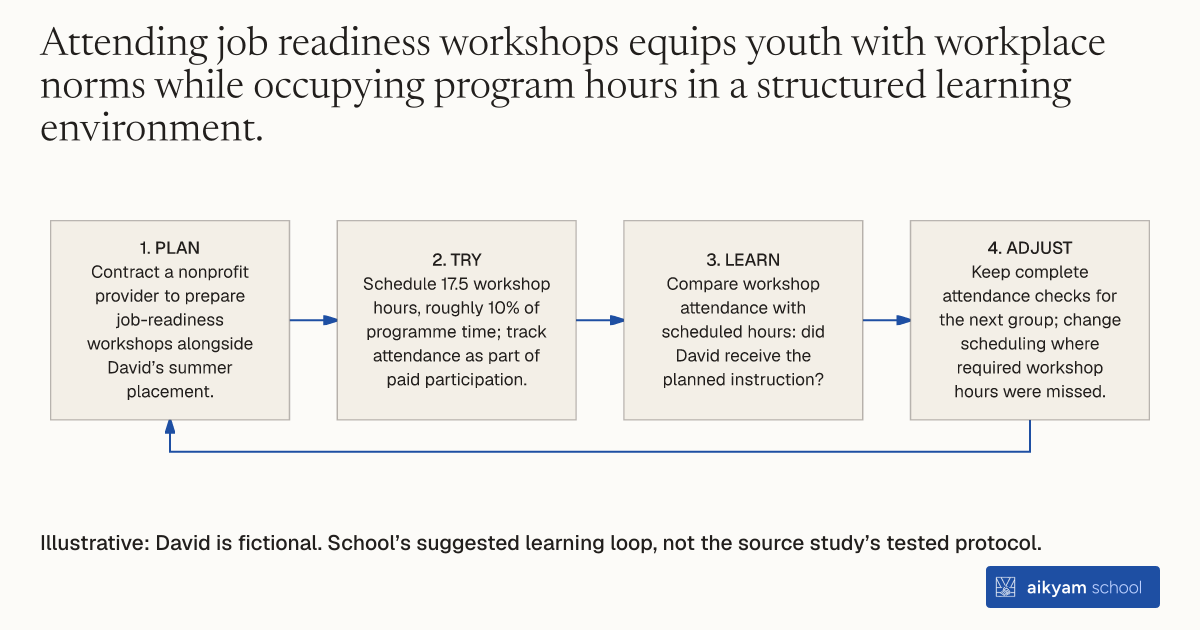
- Plan: Contract a nonprofit provider to prepare job-readiness workshops alongside David’s summer placement.
- Try: Schedule 17.5 workshop hours, roughly 10% of programme time; track attendance as part of paid participation.
- Learn: Compare workshop attendance with scheduled hours: did David receive the planned instruction?
- Adjust: Keep complete attendance checks for the next group; change scheduling where required workshop hours were missed.
Illustrative: David is fictional. School’s suggested learning loop, not the source study’s tested protocol.
See source →School’s suggested, untested learning loop. Observe workshop hours and attendance; the evaluated employment package does not isolate workshop effects.
How
When to use
Youth entering summer jobs often lack soft skills and workplace familiarity. Providing embedded instructional workshops before or during employment builds foundational workplace competencies. This method serves youth aged 14 to 21 participating in municipal summer jobs programs.
Integrate mandatory job readiness and soft skill training workshops into subsidized youth employment schedules.
- Non-profit provider organizations contract with municipal agencies to deliver job placement and instructional support.
- Provider staff prepare workshops covering job readiness and related work topics.
- Program managers schedule youth to attend 17.5 hours of workshops over the course of the summer program.
- Workshop instructors conduct training modules accounting for roughly 10 percent of total program time alongside job placements.
- Supervisors track youth workshop attendance as part of paid summer employment participation.
Why it works
Combining instructional training with practical job placement reinforces workplace routines and reduces unstructured idle time.
Example
In New York City, contracted non-profit providers delivered 17.5 hours of job readiness workshops to SYEP participants between 2005 and 2008. These workshops constituted roughly 10 percent of total program time alongside 25 hours per week of work placement. Program participation reduced summer arrests by 17 percent overall and by 23 percent among at-risk youth with prior arrests.
About the study
Participants
163,447 program applicants aged 16 to 21 (45 percent male, primarily Black and Latino, 91 percent U.S. citizens), New York City.
Study Design
Two-stage least squares instrumental variable design leveraging randomized lottery selection across provider cohorts linked to state administrative criminal records.
Results
SYEP participation (including 17.5 hours of job readiness workshops) reduced program summer arrests by 0.128 percentage points (a 17 percent drop) and total convictions by 0.0752 percentage points (a 31 percent drop). For at-risk youth, arrests fell by 2.75 percentage points (a 23 percent drop) and convictions fell by 2.09 percentage points (a 52 percent drop).