Research steps
Give recruits the same career information
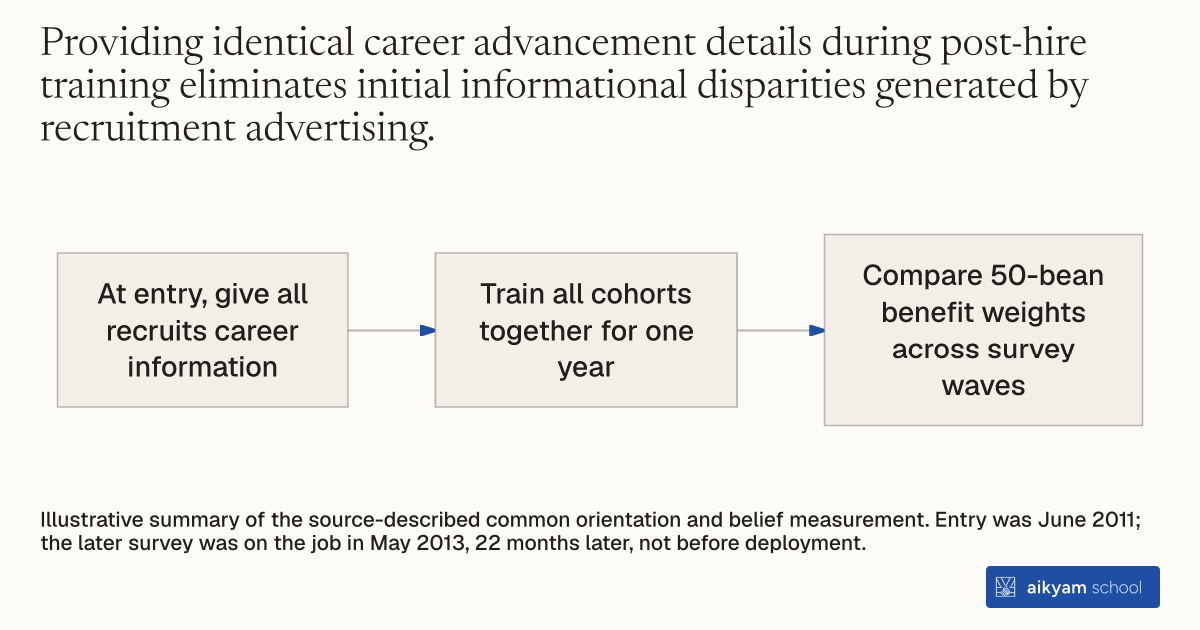
- At entry, give all recruits career information
- Train all cohorts together for one year
- Compare 50-bean benefit weights across survey waves
Illustrative summary of the source-described common orientation and belief measurement. Entry was June 2011; the later survey was on the job in May 2013, 22 months later, not before deployment.
See source →How
When to use
Public organizations recruiting workers under different informational framings need to establish uniform on-the-job incentives and eliminate post-hire misperceptions across cohorts. Varying recruitment ads risks creating persistent informational disparities regarding long-term career advancement among hired employees. Delivering standardized career incentive information during post-hire orientation aligns employee expectations across all recruitment backgrounds without impairing long-term retention.
Provide standardized civil service career information to all newly recruited frontline staff during centralized post-hire orientation to harmonize long-term incentive expectations.
- Ministry health officials convene all selected health workers at a central provincial training facility in Ndola for a one-year residential program.
- Program instructors deliver standardized orientation briefings detailing civil service career progression, promotion eligibility, and study leave policies to all trainees.
- Training managers conduct a 50-bean allocation survey at entry in June 2011 to measure initial benefit perception weights.
- Program staff deliver uniform technical and clinical health training modules across all candidate cohorts throughout the one-year curriculum.
- Training managers re-administer the bean allocation survey in May 2013 to verify convergence of perceived career opportunities before community deployment.
Why it works
This shuts down the incentive channel on the job, ensuring that subsequent differences in workplace performance are strictly driven by candidate selection.
Example
The Zambian Ministry of Health enrolled 314 newly recruited Community Health Assistants in a one-year residential training program in Ndola, Zambia. At entry, control health workers placed lower weight on career opportunities relative to treatment recruits (0.119 vs 0.164, p=0.002). Following the one-year training program, control workers' weight on career benefits increased by 27 percent to 0.151, completely converging with treatment workers (0.160, p=0.650).
About the study
Participants
314 newly recruited Community Health Assistants (307 eventual graduates, average age 26, 30 percent female) attending a one-year residential training program in Ndola, Zambia.
Study Design
Longitudinal panel survey administering a 50-bean allocation task across job benefit cards at entry (June 2011) and 22 months later on the job (May 2013) to measure belief convergence between treatment and control recruits.
Results
At entry, treatment recruits allocated 38 percent more weight to career opportunities than control recruits (0.164 vs 0.119, p=0.002). After one year of training, perceived career benefits converged with no statistically significant difference (0.160 in treatment vs 0.151 in control, p=0.650), while one-year retention remained identical at 82.3 percent in control and 82.5 percent in treatment (p=0.963).