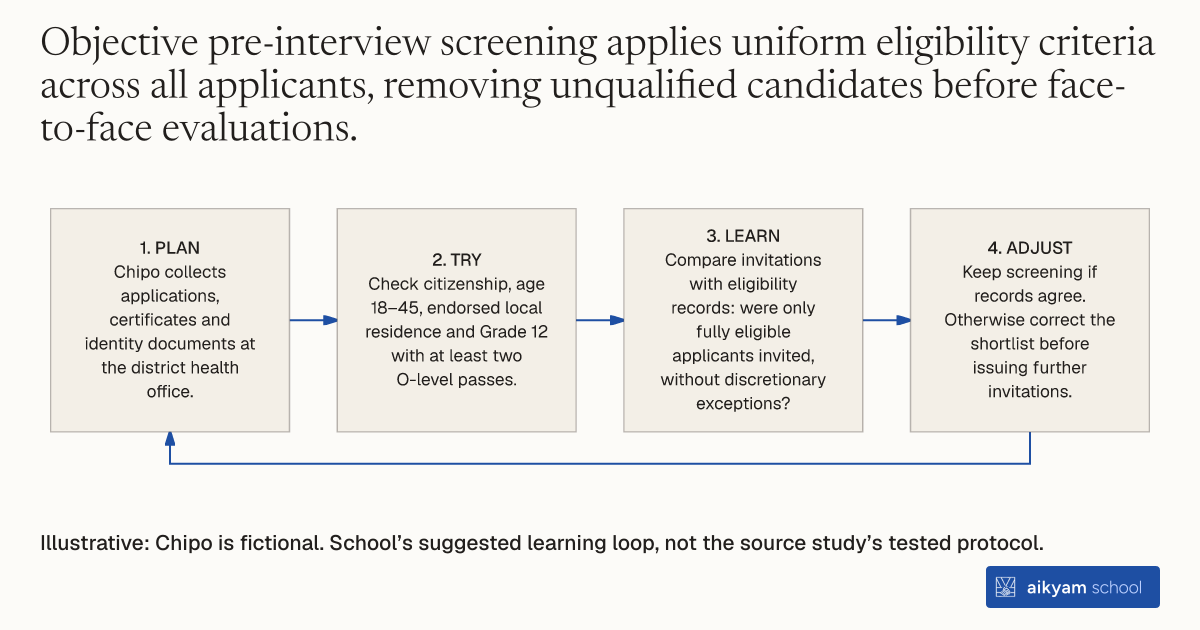
Try, learn and adjust
Check eligibility before interview invitations
- Plan: Chipo collects applications, certificates and identity documents at the district health office.
- Try: Check citizenship, age 18–45, endorsed local residence and Grade 12 with at least two O-level passes.
- Learn: Compare invitations with eligibility records: were only fully eligible applicants invited, without discretionary exceptions?
- Adjust: Keep screening if records agree. Otherwise correct the shortlist before issuing further invitations.
Illustrative: Chipo is fictional. School’s suggested learning loop, not the source study’s tested protocol.
See source →School’s suggested, untested learning loop. Observe credentials, rejections and invitations against the stated eligibility rules.
How
When to use
Public recruitment drives often attract thousands of job candidates, creating substantial administrative burdens for interview panels. Unfiltered interview pools consume time and staff resources evaluating underqualified applicants. Enforcing objective credential checks prior to scheduling interviews screens out ineligible candidates efficiently while preserving qualified applicants.
Screen submitted job applications using objective credential thresholds at central administrative offices prior to issuing interview invitations.
- District health offices collect completed physical application forms, school certificates, and identity documents submitted by local applicants.
- District health officials verify basic eligibility criteria including Zambian citizenship, age between 18 and 45 years, and local residence endorsement by a Neighborhood Health Committee.
- Administrative officials verify academic qualifications by inspecting secondary school completion certificates documenting Grade 12 completion with at least two O-level subject passes.
- Program officers reject non-compliant applications directly without issuing interview invitations or exercising discretionary adjustments.
- District offices compile shortlists of fully eligible candidates and transmit formal interview invitations to qualified applicants.
Why it works
This reduces interview costs and ensures selection panels evaluate only candidates meeting essential baseline requirements.
Example
In Zambia, district Ministry of Health offices screened 2,457 physical applications received for the Community Health Assistant program across 48 rural districts. District officials verified completion of Grade 12 with two O-level passes and local committee endorsements, deeming 1,804 applicants (73.4 percent) eligible. Qualified applicants were invited to interviews, eliminating 653 underqualified candidates prior to panel evaluation.
About the study
Participants
2,457 submitted job applications across 48 rural districts in Zambia (4.4 percent of the general population met the Grade 12 credential requirement).
Study Design
Administrative pre-interview audit comparing total submitted applications to verified eligible applications across treatment and control recruitment districts.
Results
Credential screening qualified 1,804 out of 2,457 applicants (73.4 percent), inviting 7.4 total applicants per health post down to 5.4 eligible applicants per post, with zero discretionary deviation allowed at the screening stage.