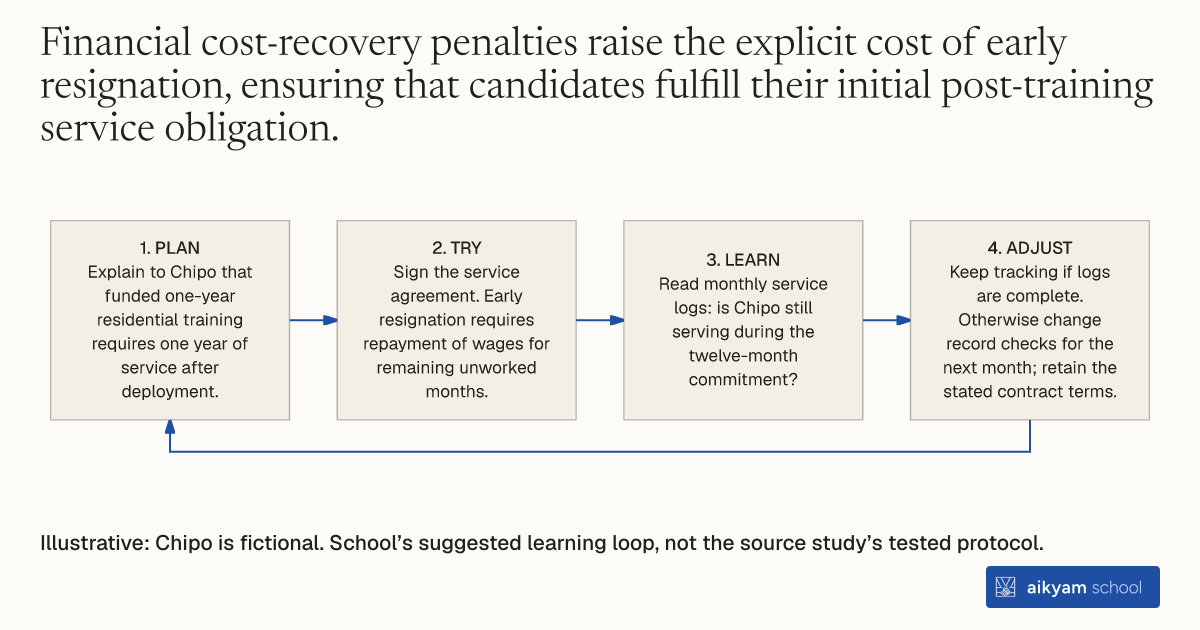
Try, learn and adjust
Check the one-year service agreement
- Plan: Explain to Chipo that funded one-year residential training requires one year of service after deployment.
- Try: Sign the service agreement. Early resignation requires repayment of wages for remaining unworked months.
- Learn: Read monthly service logs: is Chipo still serving during the twelve-month commitment?
- Adjust: Keep tracking if logs are complete. Otherwise change record checks for the next month; retain the stated contract terms.
Illustrative: Chipo is fictional. School’s suggested learning loop, not the source study’s tested protocol.
See source →School’s suggested, untested learning loop. Observe service logs and any early-resignation repayment obligation. No retention outcome is assumed.
How
When to use
Public agencies investing in extensive residential training for newly hired frontline service workers face early turnover risks. Without service commitments, newly trained personnel might leave before fulfilling basic community service obligations. Mandatory post-training service bonding paired with financial repayment liabilities ensures high initial service completion.
Bind newly trained public service staff to a mandatory one-year service contract backed by financial wage repayment penalties for early resignation.
- Ministry administrators inform newly recruited health worker candidates that participation in free government-funded residential training requires a mandatory one-year service commitment upon deployment.
- Training administrators enroll candidates in a funded one-year residential health training program with full tuition, housing, and stipends provided.
- Contract officers require graduates to sign formal service agreements obligating them to serve for at least twelve months in their assigned rural health posts.
- Program managers enforce a financial penalty requiring any worker who quits prior to completing twelve months to repay monthly wages for all remaining unworked months.
- District health officers track active monthly service delivery logs to verify ongoing health post presence through the one-year commitment window.
Why it works
This protects public investments in specialized technical training while maintaining high initial retention across frontline deployment locations.
Example
The Zambian Ministry of Health applied one-year service bonding to 307 graduating Community Health Assistants deployed across rural catchment areas. Health workers were required to repay monthly wages for any unworked months if they resigned before completing one year of service. Over 82 percent of health workers remained actively serving past the mandatory one-year commitment window across both treatment and control districts.
About the study
Participants
307 deployed Community Health Assistants (average age 26, 30 percent female) across 48 rural districts in Zambia.
Study Design
OLS regression measuring health worker retention (defined as reporting at least one visit after the 12-month commitment) across career treatment and control districts.
Results
After 12 months, 82.3 percent of control workers and 82.5 percent of treatment workers remained active (p=0.963 for difference). Overall, 18 percent of health workers dropped out after completing the bonded period, with zero workers leaving for higher-ranked civil service promotions due to a mandatory two-year waiting rule.