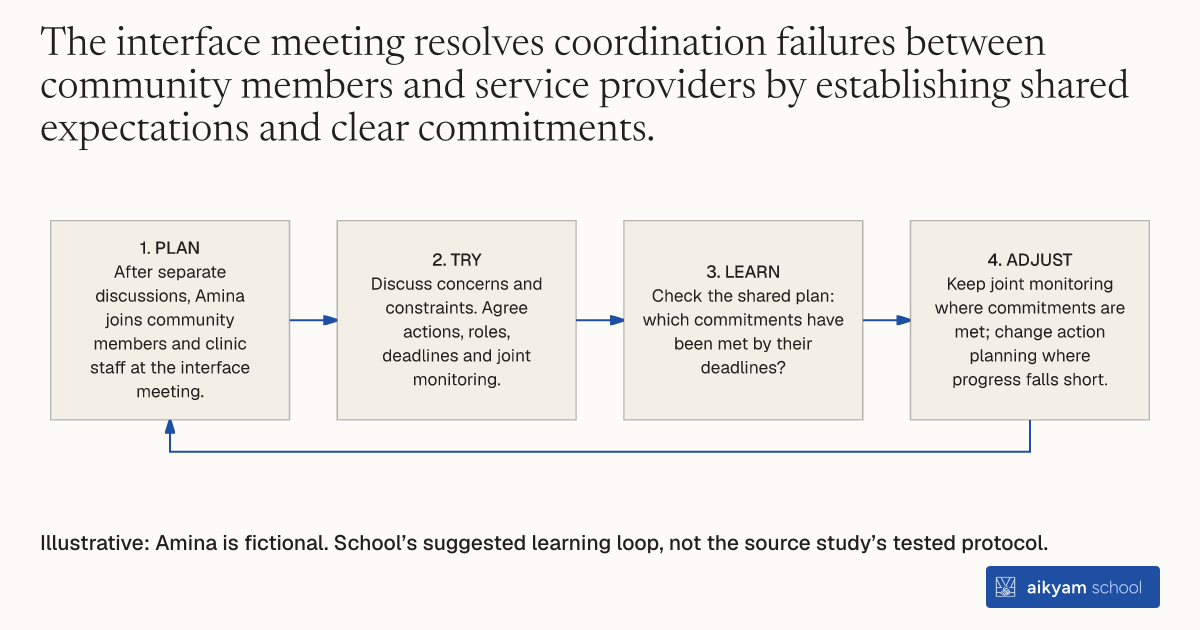
Try, learn and adjust
Check shared clinic commitments
- Plan: After separate discussions, Amina joins community members and clinic staff at the interface meeting.
- Try: Discuss concerns and constraints. Agree actions, roles, deadlines and joint monitoring.
- Learn: Check the shared plan: which commitments have been met by their deadlines?
- Adjust: Keep joint monitoring where commitments are met; change action planning where progress falls short.
Illustrative: Amina is fictional. School’s suggested learning loop, not the source study’s tested protocol.
See source →School’s suggested loop, not a tested source procedure. Observe agreed actions, deadlines and compliance; this does not isolate the meeting’s health effects.
How
When to use
Community members and health clinic staff often operate in isolation with conflicting expectations and a lack of dialogue regarding service deficits. This misalignment prevents joint problem-solving and accountability in primary care delivery. This method convenes a joint interface meeting between community members and health facility workers to negotiate a binding shared action plan for clinic improvements.
Convene a facilitated interface meeting between community representatives and health facility staff to negotiate a shared action plan for health service delivery improvements.
- CBO facilitators bring together local community members and health facility staff in a joint forum following separate baseline discussions.
- Community members present their prioritized service delivery concerns, baseline report card findings, and suggestions for improvement.
- Health facility workers share operational constraints, resource limitations, and professional perspectives regarding daily clinic management.
- CBO facilitators guide both parties through negotiations to establish mutually agreed service standards and operational commitments.
- Participants draft a shared action plan outlining required actions, designated roles, implementation deadlines, and monitoring mechanisms.
- Community members and health staff establish joint oversight arrangements to track progress and verify compliance with the contract terms.
Why it works
The resulting shared action plan serves as a local contract that enables beneficiaries to systematically monitor health workers using social rewards and sanctions.
Example
In 25 rural public primary health dispensaries in Uganda, CBO facilitators conducted interface meetings resulting in shared action plans. Following the intervention, the community action index increased from -0.42 in control facilities to 0.42 in treatment facilities, and child mortality dropped significantly in treatment catchment areas.
About the study
Participants
50 public primary health dispensaries and their corresponding catchment areas across 9 rural districts covering all four regions of Uganda.
Study Design
Randomized field experiment evaluating community-based monitoring across 25 treatment health facilities and 25 control facilities.
Results
Post-intervention ACTION index rose to 0.42 in the treatment group compared to -0.42 in the control group, representing a statistically significant difference of 0.84 (standard error 0.28).