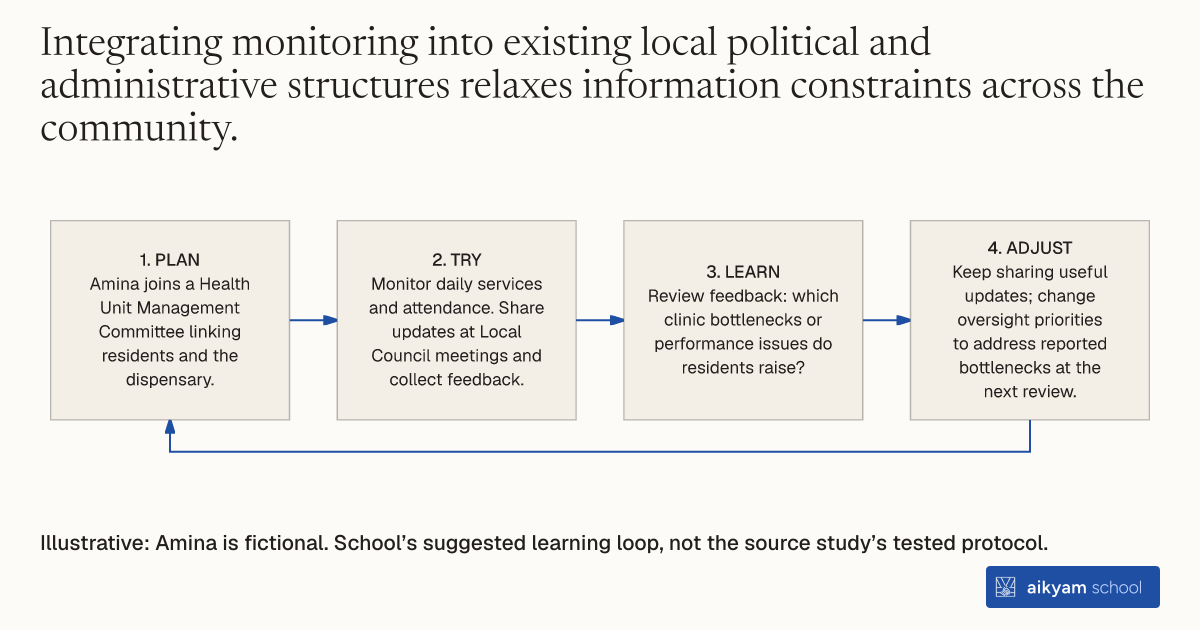
Try, learn and adjust
Check that clinic oversight reaches residents
- Plan: Amina joins a Health Unit Management Committee linking residents and the dispensary.
- Try: Monitor daily services and attendance. Share updates at Local Council meetings and collect feedback.
- Learn: Review feedback: which clinic bottlenecks or performance issues do residents raise?
- Adjust: Keep sharing useful updates; change oversight priorities to address reported bottlenecks at the next review.
Illustrative: Amina is fictional. School’s suggested learning loop, not the source study’s tested protocol.
See source →School’s suggested loop, not a tested source procedure. Observe attendance, service delivery, village discussions and committee updates.
How
When to use
Rural primary health care dispensaries often suffer from weak governance and lack ongoing beneficiary feedback. Health Unit Management Committees and local council bodies frequently fail to track facility performance or share operational updates with community members. This method uses Local Council meetings and Health Unit Management Committee oversight to maintain continuous health facility monitoring and community information sharing.
Utilize Local Council meetings and Health Unit Management Committees to oversee primary health dispensary operations and disseminate facility information to residents.
- Non-political community representatives and health facility personnel form a Health Unit Management Committee at the local dispensary.
- HUMC members monitor the day-to-day running of the primary health facility, tracking staff attendance and service delivery.
- Local Council leadership convenes regular community meetings with village households across the health facility catchment area.
- Community members discuss the functioning, management, and service quality of the local health facility during Local Council meetings.
- HUMC members share health unit performance data, management updates, and patient rights information with residents during village meetings.
- Local Council leaders aggregate citizen feedback and liaise with the HUMC to address identified clinic bottlenecks and provider performance issues.
Why it works
It provides structured channels for community members to discuss clinic performance, receive operational updates, and maintain social accountability over health workers.
Example
In 25 rural public dispensaries in Uganda where community monitoring was introduced, communities engaged Local Councils and HUMCs for health facility oversight. Following the intervention, the community information and awareness index (INFO)—which measures Local Council health facility discussions and receipt of HUMC information—rose from -0.47 in control communities to 0.47 in treatment communities.
About the study
Participants
50 public primary health dispensaries and their surrounding catchment areas across 9 rural districts in Uganda.
Study Design
Randomized field experiment evaluating community health monitoring across 25 treatment health facilities and 25 control facilities.
Results
Post-intervention INFO index reached 0.47 in the treatment group compared to -0.47 in the control group, representing a statistically significant difference of 0.94 (standard error 0.32).