Try, learn and adjust
Check health staff commitments
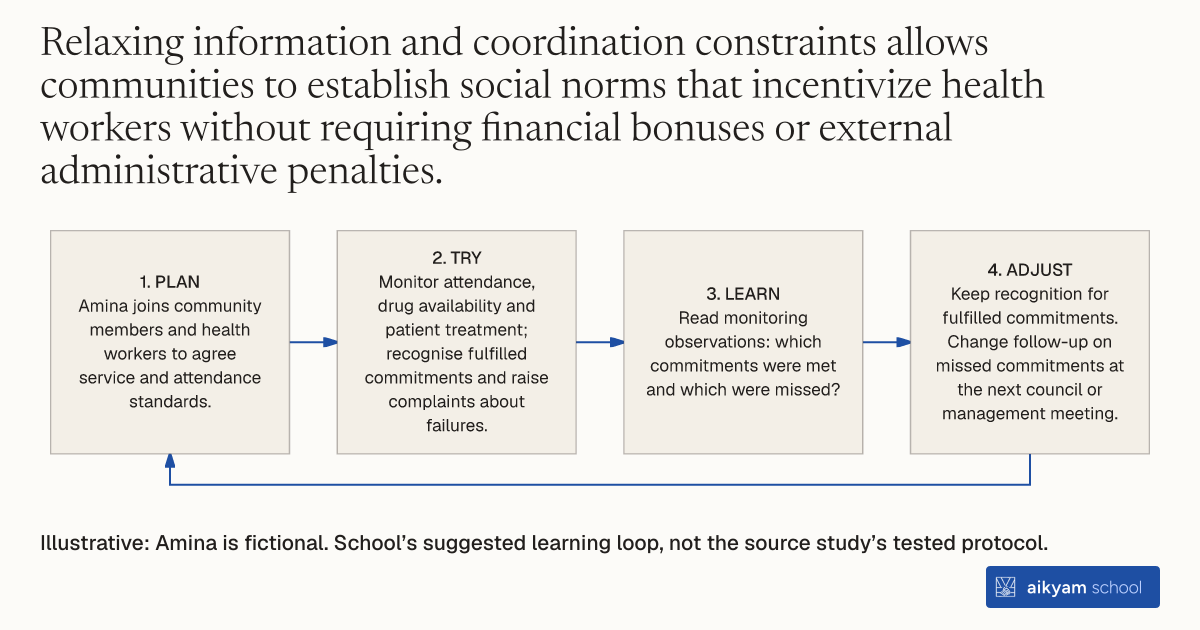
- Plan: Amina joins community members and health workers to agree service and attendance standards.
- Try: Monitor attendance, drug availability and patient treatment; recognise fulfilled commitments and raise complaints about failures.
- Learn: Read monitoring observations: which commitments were met and which were missed?
- Adjust: Keep recognition for fulfilled commitments. Change follow-up on missed commitments at the next council or management meeting.
Illustrative: Amina is fictional. School’s suggested learning loop, not the source study’s tested protocol.
See source →School’s suggested learning loop: observe agreed standards and monitoring reports; this loop does not establish a separate effect of praise or complaints.
How
When to use
Primary health clinics in developing countries face low provider effort and high worker absenteeism because formal financial incentives and managerial oversight are weak. Community monitoring interventions can leverage local social relations to incentivize clinic workers. This method enables community members to apply nonpecuniary social rewards for diligent health staff and social sanctions against shirking workers to improve primary health service delivery.
Apply nonpecuniary social rewards and sanctions to health clinic workers to enforce performance commitments established in community action plans.
- CBO facilitators assist community members and health workers in defining expected service standards and attendance obligations during interface meetings.
- Community members monitor day-to-day provider effort, staff attendance, drug availability, and patient treatment at local primary health facilities.
- Community members praise and give public recognition to health workers who fulfill clinic commitments and deliver attentive patient care.
- Community members express verbal complaints, social disapproval, and public criticism toward health workers who exhibit absenteeism or shirk duties.
- Community representatives present monitoring observations at local council and health management meetings to reinforce social pressure on clinic staff.
Why it works
Health staff respond to local reputational pressure and peer recognition within the community they serve.
Example
Across 25 rural public dispensaries in Uganda, community members used nonpecuniary social mechanisms to monitor clinic workers following facilitated report card meetings. This social oversight led to higher provider effort, increasing monthly deliveries from 9.2 in control health facilities to 15.5 in treatment facilities and raising monthly outpatient visits from 661 to 768.
About the study
Participants
50 public primary health dispensaries and their corresponding catchment areas across 9 rural districts covering all four regions of Uganda.
Study Design
Randomized field experiment evaluating community-based monitoring across 25 treatment health facilities and 25 control facilities.
Results
In treatment health facilities where community members applied social monitoring, average monthly outpatient visits reached 768 compared to 661 in control facilities, and average monthly facility deliveries reached 15.5 compared to 9.2 in control facilities.