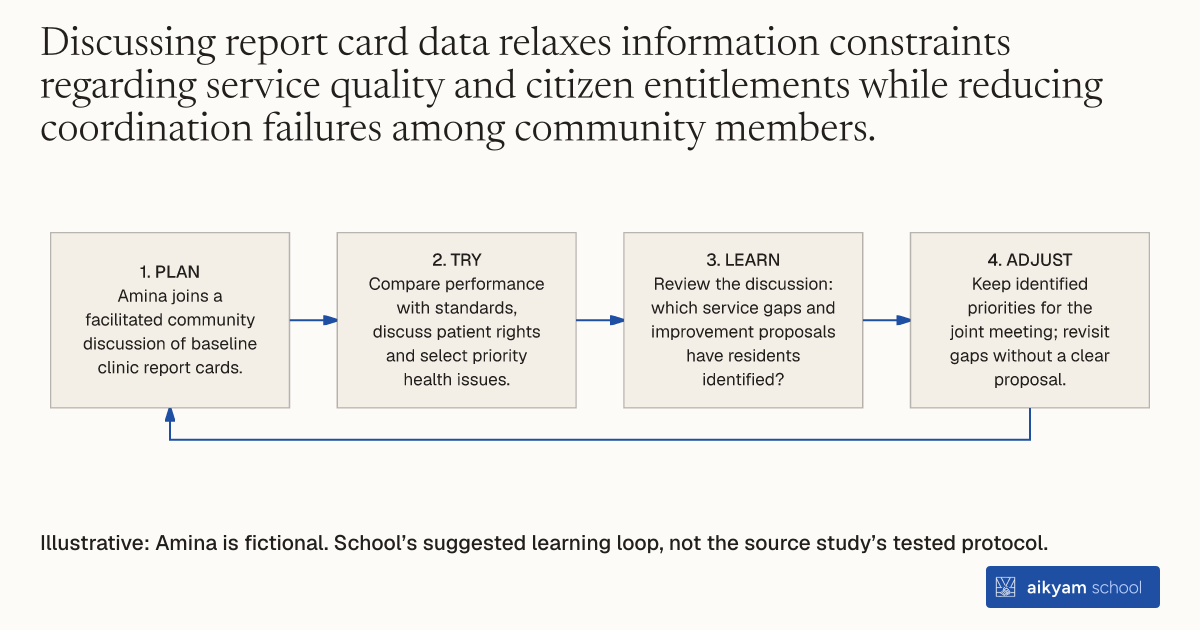
Try, learn and adjust
Check community priorities before the joint meeting
- Plan: Amina joins a facilitated community discussion of baseline clinic report cards.
- Try: Compare performance with standards, discuss patient rights and select priority health issues.
- Learn: Review the discussion: which service gaps and improvement proposals have residents identified?
- Adjust: Keep identified priorities for the joint meeting; revisit gaps without a clear proposal.
Illustrative: Amina is fictional. School’s suggested learning loop, not the source study’s tested protocol.
See source →School’s suggested loop, not a tested source procedure. Observe report card discussions, selected priorities and proposals before meeting clinic staff.
How
When to use
Rural primary health care users often lack relevant information on facility performance and community entitlements, which prevents effective monitoring. This situation creates information asymmetries that allow health service providers to operate with low effort and accountability. This method uses a facilitated community meeting to present baseline performance data and empower local citizens to demand improved service delivery.
Organize and facilitate a community meeting using citizen report cards to inform local residents about baseline primary health care performance and entitlements.
- CBO facilitators collect and aggregate baseline information on primary health care service provision, utilization, and patient rights into citizen report cards.
- CBO facilitators convene local community members in the catchment area for a dedicated participatory discussion meeting.
- CBO facilitators present and explain the baseline report card data comparing local health facility performance against official standards and regional benchmarks.
- Community members analyze key service delivery bottlenecks, provider absenteeism, and drug availability issues highlighted in the report card.
- Community participants discuss citizen rights and expectations regarding free public health services.
- Local residents select priority health issues and outline initial community-led improvement proposals ahead of joint meetings with clinic staff.
Why it works
It enables citizens to establish shared expectations and systematically organize nonpecuniary social mechanisms to hold health workers accountable.
Example
In 25 rural Ugandan dispensary catchment areas, CBO facilitators conducted baseline report card discussions with community members. Following the intervention series, the community information and awareness index increased from -0.47 in control health facilities to 0.47 in treatment communities (a difference of 0.94 standard deviation units).
About the study
Participants
50 public primary health dispensaries and their surrounding catchment areas across 9 rural districts in Uganda.
Study Design
Randomized field experiment evaluating community report card discussions across 25 treatment health facilities compared to 25 control facilities.
Results
Post-intervention community information and awareness index (INFO) rose to 0.47 in the treatment group compared to -0.47 in the control group, representing a statistically significant difference of 0.94 (standard error 0.32).