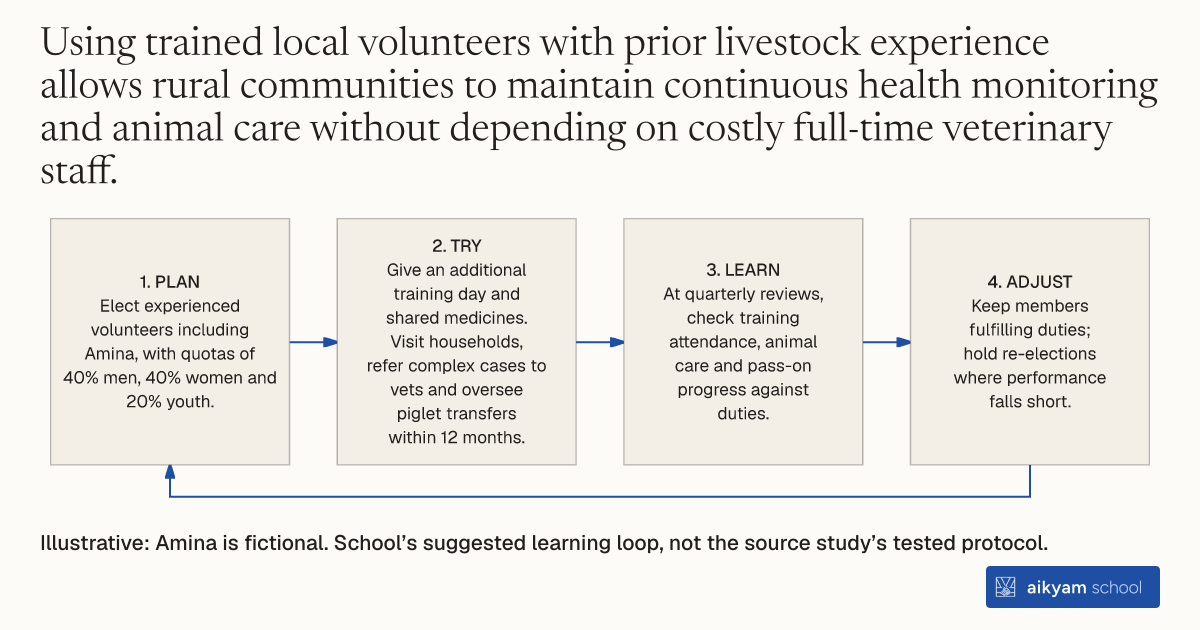
Try, learn and adjust
Check livestock support and animal transfers
- Plan: Elect experienced volunteers including Amina, with quotas of 40% men, 40% women and 20% youth.
- Try: Give an additional training day and shared medicines. Visit households, refer complex cases to vets and oversee piglet transfers within 12 months.
- Learn: At quarterly reviews, check training attendance, animal care and pass-on progress against duties.
- Adjust: Keep members fulfilling duties; hold re-elections where performance falls short.
Illustrative: Amina is fictional. School’s suggested learning loop, not the source study’s tested protocol.
See source →School’s suggested loop, not a tested source procedure. Observe at least 90% family training attendance, veterinary referrals and transfers. This loop is not veterinary treatment guidance.
How
When to use
Rural smallholder farming communities introducing livestock often lack localized veterinary support, leading to animal sickness, poor pass-on model compliance, and high livestock mortality. Establishing an elected village livestock committee creates community-level mentorship and local healthcare management for animals. This method suits rural poverty reduction programmes that distribute livestock or conduct animal husbandry training across entire villages.
Establish an elected village livestock committee to manage community veterinary inputs, provide peer coaching, and oversee animal pass-on transfers.
- Elect volunteer committee members with prior livestock experience from the village using demographic quotas of 40% men, 40% women, and 20% youth.
- Provide committee members with an additional day of advanced livestock training on administering medications and vaccinations.
- Supply the committee with village-level livestock inputs, including vaccines and animal medicines, to make available to all households.
- Conduct routine household check-ins across the community to ensure that at least 90% of families attend livestock training and adopt recommended shelter and feeding practices.
- Provide basic disease diagnosis, administer simple medications or vaccinations, and refer complex cases to professional veterinarians.
- Oversee the pass-on of piglets from primary animal recipients to secondary group households within 12 months.
- Participate in quarterly monitoring reviews with project officers, undergoing re-election if performance falls short.
Why it works
Peer mentorship ensures high training compliance and keeps communal animal medicines accessible to all villagers.
Example
In rural western Uganda, Raising the Village instituted elected livestock committees in treated communities, where volunteer members spent approximately 155 hours over two years providing peer coaching, managing animal health inputs, and helping increase livestock earnings by USD 4.459 PPP per month.
About the study
Participants
3,852 households across 335 villages in Kagadi and Kyenjojo districts, western Uganda, where 35% of households fall below the \$2.15 PPP daily poverty line post-harvest and 65% during the lean season.
Study Design
Clustered randomized controlled trial across 114 village clusters covering 335 villages, comparing a universal livelihoods program to a pure control group.
Results
Value of livestock holdings increased by USD 183.734 PPP (p < 0.01), monthly livestock and animal product income increased by USD 4.459 PPP (38%, p < 0.01), and the share of households earning animal income rose by 0.084 (p < 0.01).