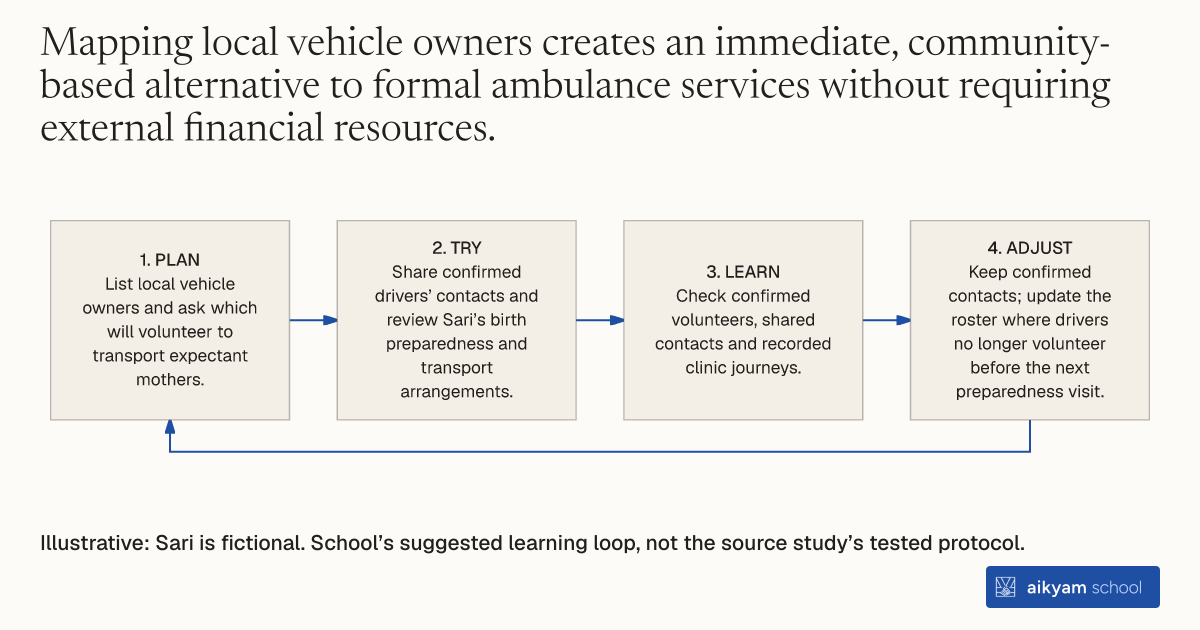
Try, learn and adjust
Check voluntary transport contacts are ready
- Plan: List local vehicle owners and ask which will volunteer to transport expectant mothers.
- Try: Share confirmed drivers’ contacts and review Sari’s birth preparedness and transport arrangements.
- Learn: Check confirmed volunteers, shared contacts and recorded clinic journeys.
- Adjust: Keep confirmed contacts; update the roster where drivers no longer volunteer before the next preparedness visit.
Illustrative: Sari is fictional. School’s suggested learning loop, not the source study’s tested protocol.
See source →Observe volunteer agreements, contact availability and transport use; do not assume a safe clinical outcome. School suggests this learning loop; it was not tested by the source.
How
When to use
Rural expectant mothers struggle to reach distant medical facilities during labor due to a lack of available ambulances or affordable transport options. Local community representatives need a grassroots transportation system that utilizes existing local resources. Organizers deploy this method to establish a list of voluntary vehicle drivers who transport women in labor to health clinics.
Identify and mobilize local vehicle owners to provide emergency transportation for pregnant women.
- Compile a roster of village residents who own functional motor vehicles or cars.
- Visit each identified vehicle owner individually to ask if they will voluntarily transport expectant mothers in emergency situations.
- Publish and share the list of confirmed volunteer drivers and their contact information with the broader village community.
- Track pregnant women who are approaching their expected due dates across village sub-districts.
- Visit expectant mothers to review birth preparedness plans and establish emergency transport protocols using the volunteer driver roster.
Why it works
Establishing advance agreements with drivers removes transport uncertainty and enables timely referrals during labor emergencies.
Example
In an Indonesian village, community representatives listed 10 vehicle owners, approached them individually, and secured 4 volunteer drivers whose names were shared with the village. The drivers safely transported 5 pregnant women to the clinic by the end of the intervention period.
About the study
Participants
200 rural treatment villages across two regions in Indonesia and two regions in Tanzania, with detailed tracking of community transportation actions across 100 Indonesian villages.
Study Design
Randomized controlled trial evaluating a non-prescriptive civic deliberation program, gathering social action plans and key informant interview verification data on community-organized transportation systems.
Results
Community-organized transportation actions were designed by 8.5% of communities overall (15.0% in Indonesia and 2.0% in Tanzania), with participants successfully recruiting local drivers to transport expectant mothers to health facilities.