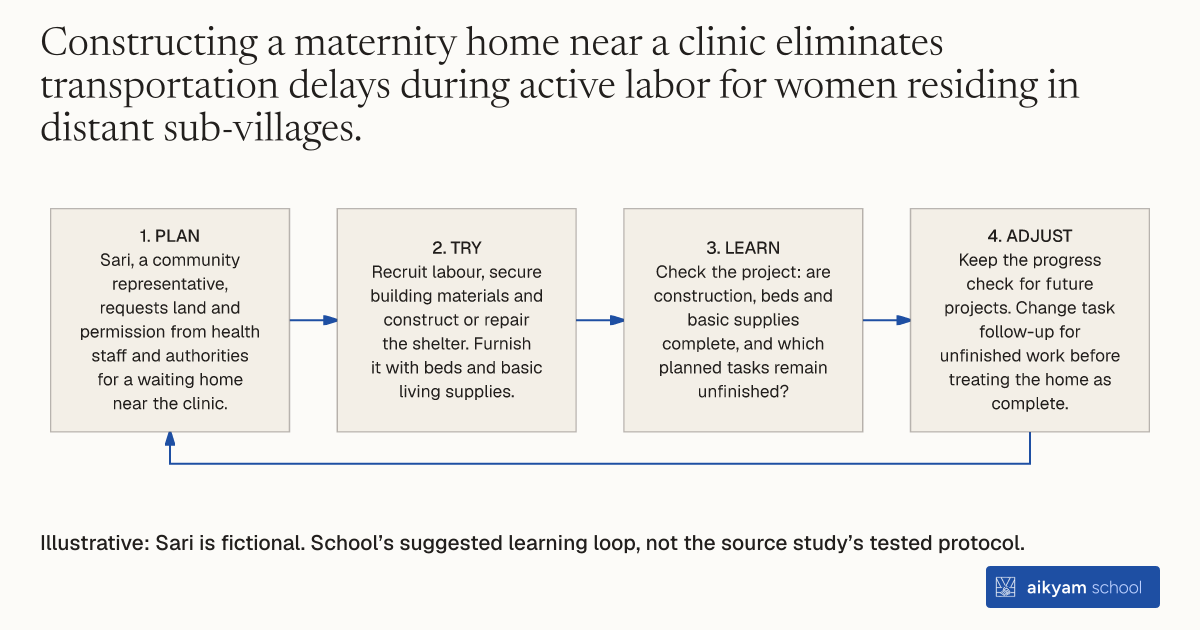
Try, learn and adjust
Check maternity waiting-home construction is complete
- Plan: Sari, a community representative, requests land and permission from health staff and authorities for a waiting home near the clinic.
- Try: Recruit labour, secure building materials and construct or repair the shelter. Furnish it with beds and basic living supplies.
- Learn: Check the project: are construction, beds and basic supplies complete, and which planned tasks remain unfinished?
- Adjust: Keep the progress check for future projects. Change task follow-up for unfinished work before treating the home as complete.
Illustrative: Sari is fictional. School’s suggested learning loop, not the source study’s tested protocol.
See source →School's suggested, untested loop: observe permission, materials, construction and furnishing; completion alone does not establish safe care.
How
When to use
Rural expectant mothers living far from health facilities face severe travel barriers and delay reaching medical care when labor begins. Community organizers need a local infrastructure solution that allows pregnant women to stay near healthcare staff before delivery. Organizers mobilize community labor and materials to construct maternity waiting homes adjacent to dispensaries.
Mobilize community members to construct or repair a dedicated waiting home near the local primary health facility for expectant mothers.
- Recruited community representatives meet with local health facility staff and village authorities to request land and permission for a maternity resting home.
- Convene a public village meeting to present the construction plan and secure volunteer labor and local building materials from residents.
- Procure necessary structural inputs, such as bricks, timber, and roofing materials, through community fundraising or district government requests.
- Organize community work brigades to construct or renovate a physical shelter adjacent to the dispensary or health center.
- Furnish the completed facility with beds and basic living supplies so pregnant women can wait safely near medical staff prior to delivery.
Why it works
Providing a safe waiting space allows expectant mothers to be monitored by health personnel prior to giving birth.
Example
In rural Tanzanian program villages, community representatives mobilized residents to construct maternity resting homes, with 8.0% of Tanzanian communities designing maternity home construction projects to ensure mothers could wait near health dispensaries before delivery.
About the study
Participants
200 rural treatment villages across two regions in Indonesia (100 villages) and two regions in Tanzania (100 villages).
Study Design
Two randomized controlled trials evaluating a non-prescriptive civic deliberation intervention, collecting standardized social action plans over a 90-day intervention period.
Results
Maternity home construction was designed in 4.0% of villages overall (8.0% in Tanzania and 0.0% in Indonesia), representing 9.9% of all facility infrastructure actions overall and 28.6% of facility infrastructure actions in Tanzania, achieving a 33.3% completion rate in Tanzania within 90 days.