Try, learn and adjust
Check payments go to the designated caregiver
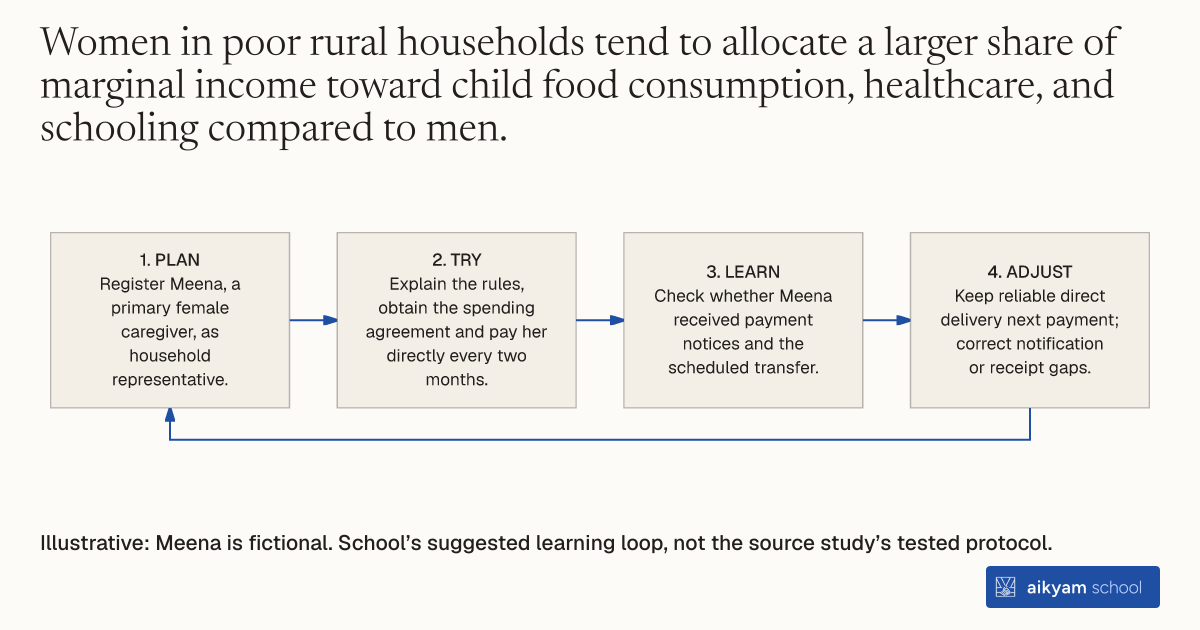
- Plan: Register Meena, a primary female caregiver, as household representative.
- Try: Explain the rules, obtain the spending agreement and pay her directly every two months.
- Learn: Check whether Meena received payment notices and the scheduled transfer.
- Adjust: Keep reliable direct delivery next payment; correct notification or receipt gaps.
Illustrative: Meena is fictional. School’s suggested learning loop, not the source study’s tested protocol.
See source →Designated recipient, payment notices and transfer receipt. School’s suggested learning loop, not a source-tested cycle.
How
When to use
In impoverished rural households, male heads of household often control finances and may prioritize personal spending over household health and nutrition needs. Assigning cash transfer disbursements directly to mothers or female caregivers leverages women's preference for spending on child welfare. This method ensures social safety net transfers directly improve family food security and health investments.
Appoint primary female caregivers as official household representatives to receive bimonthly cash transfers and manage household investments.
- Program administrators register beneficiary households and appoint the mother or primary female caregiver as the designated household representative.
- Program staff conduct community registration assemblies to explain payment schedules, conditionalities, and program objectives to designated female caregivers.
- Program administrators require designated female caregivers to sign a short agreement promising to allocate funds toward household nutrition, health, and schooling.
- Program staff disburse bimonthly cash transfers directly to designated female representatives at scheduled payment sites.
- Community volunteer promotora coordinators notify designated female representatives about upcoming transfer payments and compliance status.
Why it works
Combining direct cash delivery to women with explicit social marketing messages reinforces female control over funds and directs resources toward child human capital.
Example
In six rural Nicaraguan municipalities, the Red de Protección Social designated mothers or female caregivers as transfer recipients in over 95 percent of beneficiary households. This direct payment strategy delivered bimonthly transfers averaging 18 percent of baseline household expenditure, contributing to a 35 percent increase in per capita food consumption and significant increases in animal protein, fruit, and vegetable purchases.
About the study
Participants
Beneficiary households across 42 rural comarcas in central and northern Nicaragua containing approximately 250 households per locality.
Study Design
Clustered randomized controlled trial delivering conditional cash transfers exclusively to designated household representatives, over 95 percent of whom were women.
Results
Delivering bimonthly cash transfers representing an average of 18 percent of pre-program expenditures to designated female representatives achieved an 85 percent program take-up rate and increased household log per capita food consumption by 34.5 percent after two years.