Research steps
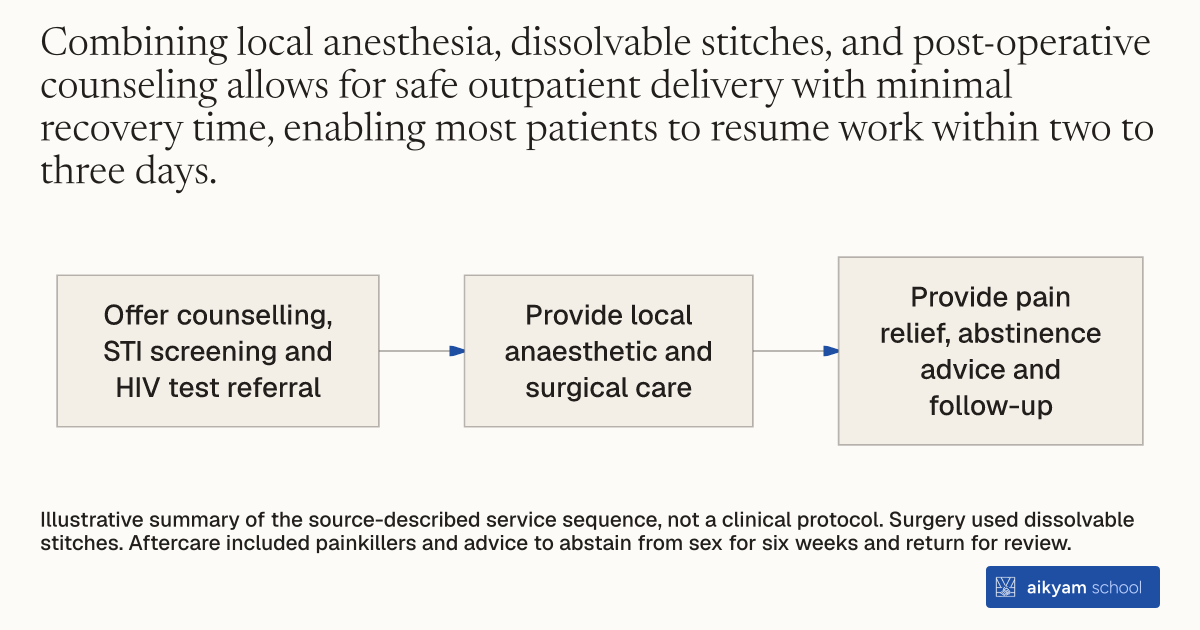
Describe the outpatient care sequence
- Offer counselling, STI screening and HIV test referral
- Provide local anaesthetic and surgical care
- Provide pain relief, abstinence advice and follow-up
Illustrative summary of the source-described service sequence, not a clinical protocol. Surgery used dissolvable stitches. Aftercare included painkillers and advice to abstain from sex for six weeks and return for review.
See source →How
When to use
In urban health settings where public facilities prioritize acute surgical emergencies over elective preventive care, adult men lack accessible, safe circumcision services. Offering integrated outpatient clinical procedures allows uncircumcised adult men to access minor surgical prevention services safely. This method delivers voluntary surgical male circumcision within a routine outpatient reproductive health setting.
Provide outpatient voluntary adult medical male circumcision using standard surgical protocols at a specialized health clinic.
- Offer individual counseling, STI screening, and voluntary HIV testing referral to clients presenting at the clinic.
- Administer local anesthetic injection prior to surgery.
- Perform the surgical circumcision using dissolvable stitches.
- Provide painkillers to the patient for multi-day post-operative pain management.
- Advise the patient to observe a six-week period of sexual abstinence and return for a follow-up review visit.
Why it works
Integrating the procedure into an established reproductive health clinic provides consistent medical oversight and structured follow-up care.
Example
A private health clinic branch in Lilongwe, Malawi performed 43 voucher-redeemed outpatient circumcisions for adult men aged 18 to 35 over a three-month validity period, with patients receiving local anesthesia, painkillers, and follow-up guidance.
About the study
Participants
1,634 uncircumcised men aged 18 to 35 residing in urban Lilongwe, Malawi.
Study Design
Outpatient surgical service provision delivered at a partner health clinic branch to trial participants redeeming subsidized vouchers.
Results
43 uncircumcised men redeemed vouchers and received medical male circumcisions at the partner clinic, achieving a 2.63 percent take-up rate among baseline survey respondents.