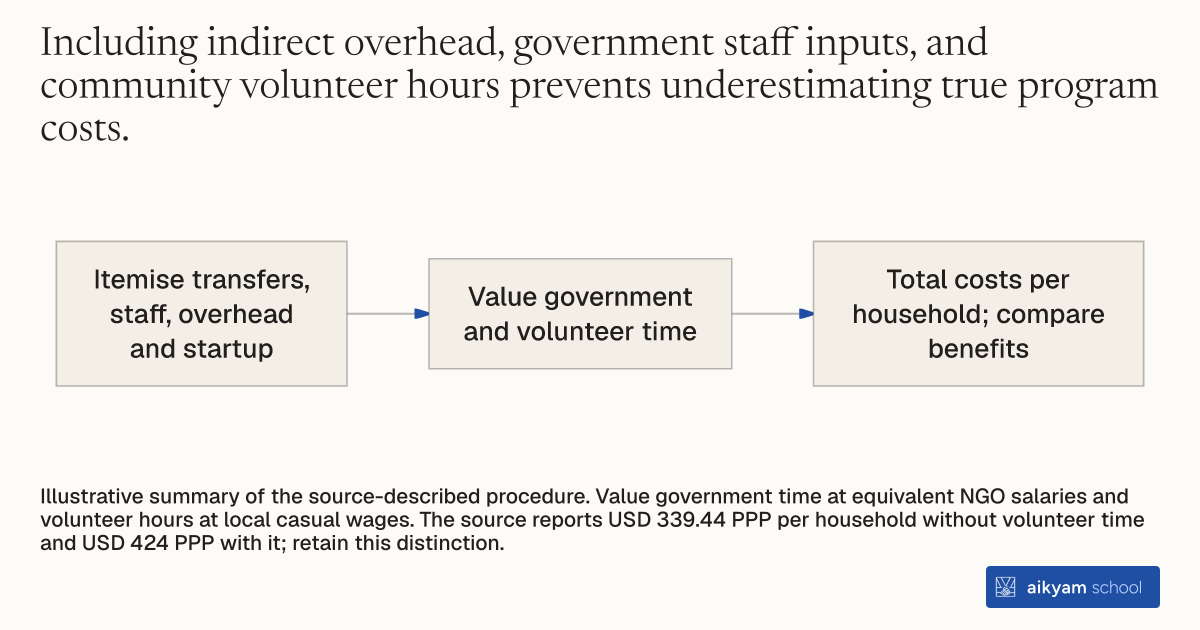
Research steps
Account for programme and volunteer costs
- Itemise transfers, staff, overhead and startup
- Value government and volunteer time
- Total costs per household; compare benefits
Illustrative summary of the source-described procedure. Value government time at equivalent NGO salaries and volunteer hours at local casual wages. The source reports USD 339.44 PPP per household without volunteer time and USD 424 PPP with it; retain this distinction.
See source →How
When to use
Non-governmental organisations and researchers evaluating anti-poverty interventions need a comprehensive method to account for direct, indirect, and community volunteer costs when calculating cost-effectiveness. Standard financial tracking often omits organizational overhead, local staff travel, or uncompensated community volunteer hours, distorting true program cost comparisons. This accounting approach calculates full per-household intervention expenses to establish accurate benefit-cost ratios for rural livelihood programs.
Calculate comprehensive per-household intervention costs by aggregating direct asset transfers, staff personnel costs, organizational overhead, startup expenses, and community volunteer hours.
- Itemize all direct asset and input transfers distributed to households and community groups, including seeds, tools, livestock, and infrastructure materials.
- Record all project personnel expenses, including staff salaries, travel costs, and government partner time valued at equivalent NGO officer salary rates.
- Allocate local and international indirect support costs, including office overhead, international fundraising, and program development, proportional to active project communities.
- Account for startup expenses including community identification, climatic data collection, and local needs assessments.
- Quantify uncompensated community committee volunteer hours and value them using prevailing local casual daily wage rates.
- Divide total program expenditure across all target households to determine the true cost per household and calculate multi-year benefit-cost ratios.
Why it works
Standardizing expenses on a per-household basis enables rigorous cost-effectiveness comparisons across competing anti-poverty models.
Example
In rural western Uganda, Raising the Village calculated a direct program cost of USD 339 PPP per household (USD 393 PPP when inflated to year three), yielding a three-year benefit-cost ratio of 267% compared to control communities.
About the study
Participants
3,852 households across 335 villages in Kagadi and Kyenjojo districts, western Uganda, where 35% of households fall below the \$2.15 PPP daily poverty line post-harvest and 65% during the lean season.
Study Design
Clustered randomized controlled trial across 114 village clusters covering 335 villages, comparing a universal livelihoods program to a pure control group using a three-year cost-effectiveness analysis.
Results
Direct program costs were USD 339.44 PPP per household (USD 130.86 PPP input transfers, USD 58.94 PPP personnel costs, USD 138.61 PPP indirect costs, USD 11.03 PPP startup costs); accounting for 155 volunteer hours per committee member increased total costs to USD 424 PPP per household, yielding a 214% benefit-cost ratio compared to 267% without volunteer time.