Research groups
Allocate summer jobs within provider pools
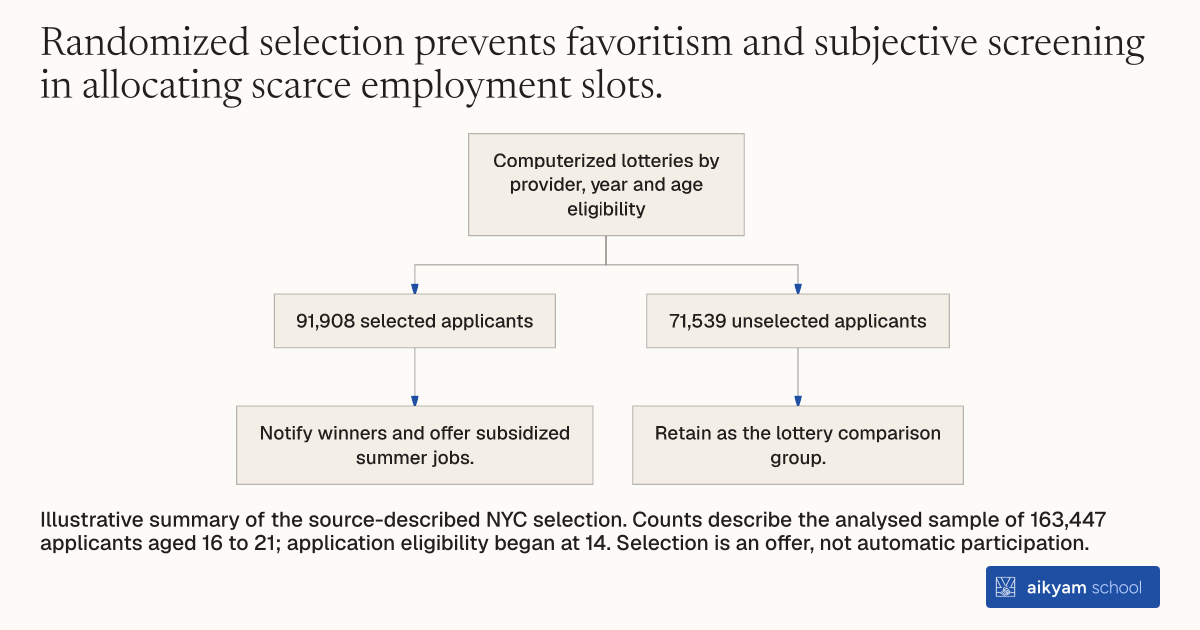
Computerized lotteries by provider, year and age eligibility
- 91,908 selected applicants
- Notify winners and offer subsidized summer jobs.
- 71,539 unselected applicants
- Retain as the lottery comparison group.
Illustrative summary of the source-described NYC selection. Counts describe the analysed sample of 163,447 applicants aged 16 to 21; application eligibility began at 14. Selection is an offer, not automatic participation.
See source →How
When to use
Summer jobs programs face more applicants than available positions. Running a lottery assigns oversubscribed job slots fairly without bias. This method serves municipal youth development agencies managing citywide employment applications.
Allocate oversubscribed youth employment slots through randomized computerized lotteries within contracted community provider pools.
- Municipal agencies open public application windows for youth aged 14 to 21 across local provider organizations.
- Applicants submit personal identification and select a local community provider.
- Agency administrators group applicants into lottery pools defined by provider, program year, and age eligibility.
- Program computers execute randomized selection lotteries within each provider pool to select slot winners.
- Provider staff notify selected winners and offer them subsidized summer job placements.
Why it works
This computerized process provides an unconfounded baseline to compare program winners against unselected applicants.
Example
The New York City Department of Youth and Community Development received applications from roughly 8 percent of eligible city youth between 2005 and 2008. Because the program could only fund jobs for about half of the applicants, administrators ran computerized lotteries within provider pools. Out of 163,447 applicants aged 16 and older, 91,908 won a lottery slot and 71,539 were not selected. Winning a lottery increased program participation by over 60 percentage points and reduced program summer arrests by 17 percent.
About the study
Participants
163,447 program applicants aged 16 to 21 (91,908 lottery winners and 71,539 lottery losers), New York City.
Study Design
Randomized selection lottery design evaluated using two-stage least squares instrumental variables controlling for provider-by-year lottery fixed effects.
Results
Winning a lottery increased SYEP participation significantly (first-stage effect of 68.98 percentage points, p < 0.01). Lottery selection led to a 17 percent drop in summer arrests (0.128 percentage points) and a 31 percent drop in convictions (0.0752 percentage points).