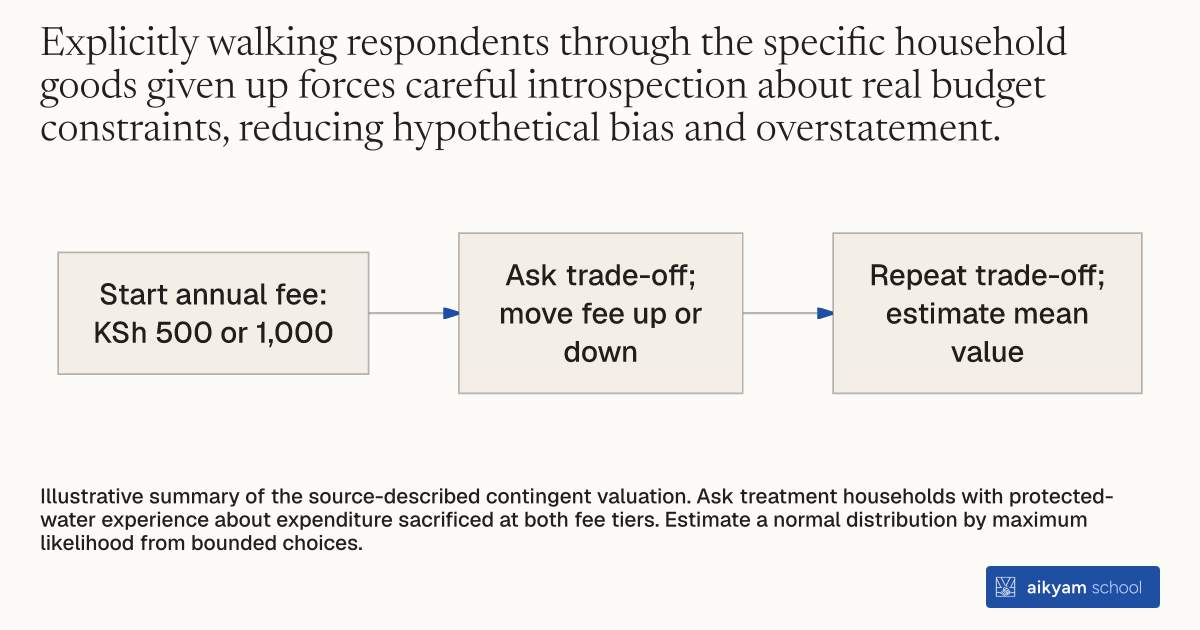
Research steps
Bound willingness to pay for water
- Start annual fee: KSh 500 or 1,000
- Ask trade-off; move fee up or down
- Repeat trade-off; estimate mean value
Illustrative summary of the source-described contingent valuation. Ask treatment households with protected-water experience about expenditure sacrificed at both fee tiers. Estimate a normal distribution by maximum likelihood from bounded choices.
See source →How
When to use
When user fees or market prices do not exist, health policy planners need to estimate household monetary willingness to pay for public infrastructure improvements. Standard contingent valuation surveys often overstate willingness to pay because respondents do not carefully consider their real budget constraints. Presenting respondents with explicit expenditure trade-offs grounds hypothetical survey choices in realistic household budget choices.
Elicit household monetary willingness to pay for clean water using closed-ended contingent valuation questions accompanied by explicit expenditure trade-off prompts.
- Survey enumerators select households in treatment communities with firsthand experience using protected water points.
- Enumerators present an initial annual fee anchor of 500 or 1,000 Kenyan shillings for annual water protection maintenance.
- Enumerators ask respondents if they would pay the initial fee, explicitly describing the specific household goods or expenditures given up to pay that amount.
- Enumerators present the next higher or lower monetary fee tier based on the respondent's initial response.
- Enumerators repeat the explicit expenditure trade-off prompt for the second monetary tier to obtain bounded willingness-to-pay choices.
- Econometricians estimate maximum likelihood normal distributions over the bounded choices to calculate mean population willingness to pay.
Example
Survey enumerators asked households in treatment communities in Busia and Butere-Mumias districts of western Kenya about their willingness to pay for one year of spring protection; emphasizing expenditure trade-offs reduced stated willingness to pay by 11 to 14 percentage points, yielding an estimated mean annual willingness to pay of 17.64 US dollars per household.
About the study
Participants
Treatment group households with firsthand spring protection experience across 184 spring communities in Busia and Butere-Mumias districts, Kenya.
Study Design
Closed-ended contingent valuation elicitation with randomized starting price anchors (250, 500, or 1,000 Kenyan shillings), explicit expenditure trade-off prompts, and maximum likelihood distribution fitting.
Results
Emphasizing expenditure trade-offs reduced reported willingness to pay by 11 to 14 percentage points; respondents starting at 500 KSh reported a mean WTP of \$23.91 USD compared to \$12.62 USD for those starting at 250 KSh, with an overall mean WTP of \$17.64 USD (standard deviation \$13.09 USD).