Research steps
Compare hypothetical demand
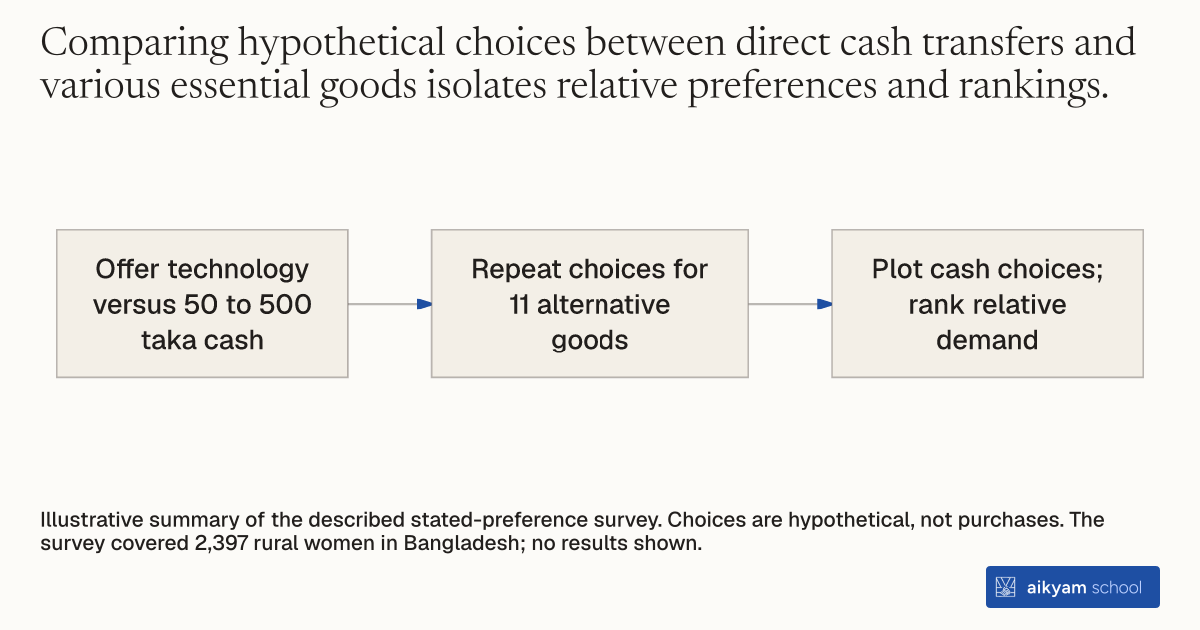
- Offer technology versus 50 to 500 taka cash
- Repeat choices for 11 alternative goods
- Plot cash choices; rank relative demand
Illustrative summary of the described stated-preference survey. Choices are hypothetical, not purchases. The survey covered 2,397 rural women in Bangladesh; no results shown.
See source →How
When to use
Researchers need to evaluate relative consumer demand for a new technology against essential public and private goods. Standard valuation questions risk hypothetical bias when measured in isolation. Offering systematic cash-versus-good tradeoffs traces relative demand curves across competing household priorities.
Measure relative household demand for a target technology by comparing hypothetical choice decisions against cash transfers and alternative essential goods.
- Present survey respondents with a choice between receiving a target technology or varying cash amounts ranging systematically from ৳50 to ৳500 (\$0.72 to \$7.20).
- Repeat the hypothetical binary choices for a set of 11 alternative essential goods, including medical consultations, schooling, paved roads, electricity, tube wells, sanitary latrines, high-yield seeds, and flood embankments.
- Plot the percentage of respondents choosing direct cash over each good across the offered cash amounts to trace relative demand curves.
- Rank the target technology and alternative goods by relative price sensitivity and overall willingness to accept cash instead of the good.
Why it works
This approach avoids relying on cardinal valuations, which are vulnerable to hypothetical survey bias.
Example
Researchers administered this survey across 2,397 rural Bangladeshi women in 2006 to evaluate cookstove demand against 11 alternative goods. At ৳500 (\$7.20), over 95% of respondents preferred cash over a cookstove, making cookstoves the most price-sensitive good surveyed.
About the study
Participants
2,397 rural women across 120 villages in Bangladesh.
Study Design
Contingent valuation survey using systematic cash-versus-good choices (৳50 to ৳500) administered across 11 public and private goods in 2006.
Results
Nontraditional cookstove demand was more price-sensitive than all 11 alternative goods, with 90% to 95% of respondents preferring direct cash transfers over cookstoves across all tested monetary amounts.