Research survey
Measure stated willingness to pay for guards
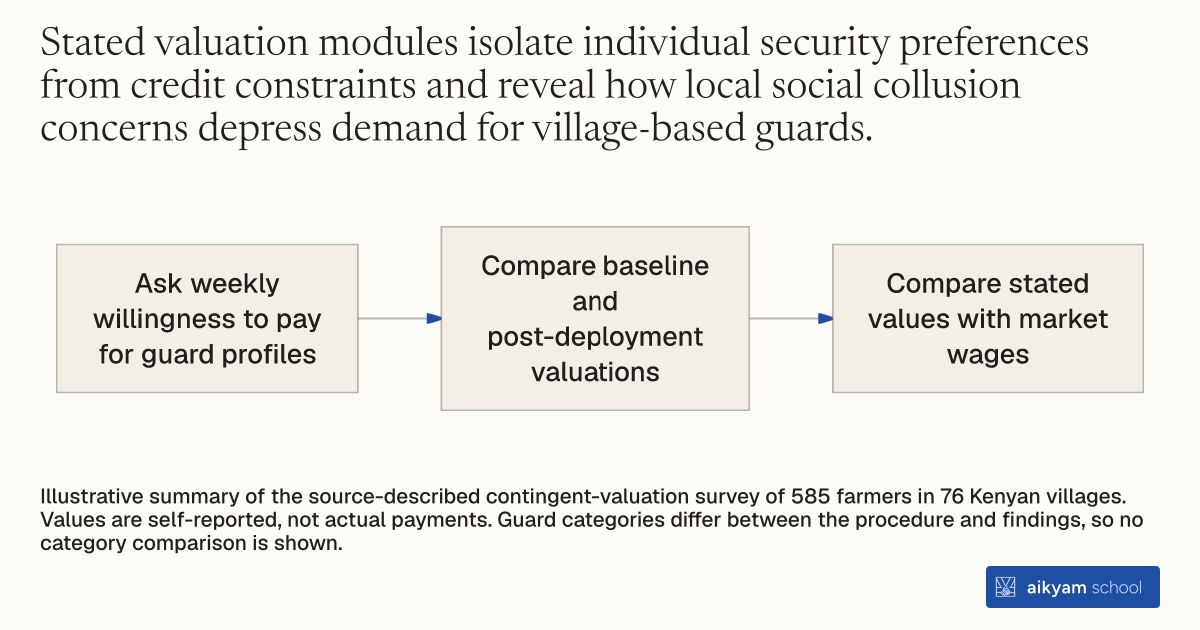
- Ask weekly willingness to pay for guard profiles
- Compare baseline and post-deployment valuations
- Compare stated values with market wages
Illustrative summary of the source-described contingent-valuation survey of 585 farmers in 76 Kenyan villages. Values are self-reported, not actual payments. Guard categories differ between the procedure and findings, so no category comparison is shown.
See source →How
When to use
Rural smallholders often under-value formal or informal property protection services due to liquidity constraints or low market exposure. Evaluating farmer demand across different guard profiles helps program designers determine cost-recovery potential and identify preferences for outsider versus local security.
Measure farmer willingness to pay for alternative security guard configurations using structured contingent valuation survey modules.
- Present survey respondents with hypothetical weekly hiring scenarios for three distinct security guard categories: local friends, local non-friends, and outsider Maasai watchmen.
- Elicit self-reported weekly willingness to pay in local currency for each guard profile using standardized open-ended valuation questions.
- Compare baseline willingness to pay values against post-deployment endline valuations to capture changes in guard valuation after experiencing security benefits.
- Calculate willingness to pay differentials across guard profiles to isolate the specific valuation premium placed on outsider status versus ethnic pastoralist stereotypes.
- Contrast stated willingness to pay against actual market watchman wages to determine the required subsidy or cost-sharing gap for program sustainability.
Why it works
Comparing valuations across guard profiles quantifies the economic value farmers assign to non-collusive outsider status and cultural enforcement reputations.
Example
Researchers elicited self-reported weekly willingness to pay for watchmen from 585 smallholders in Migori County, Kenya. Farmers reported a willingness to pay of roughly 200 KES/week for local friends, 380 KES/week for local non-friends, and 650 KES/week for outsider Maasai watchmen, demonstrating a significant premium for non-collusive outsider security.
About the study
Participants
585 smallholding farmers across 76 villages in Suna East, Suna West, and Uriri sub-counties, Migori County, Kenya.
Study Design
Survey-based contingent valuation module administered at baseline and endline to measure weekly willingness to pay across three guard categories (local friends, local non-friends, and outsider Maasai).
Results
Stated willingness to pay for Maasai watchmen (~650 KES/week) was significantly higher than for non-local non-Maasai guards (~380 KES/week, p < 0.001) and local friends (~200 KES/week, p < 0.001), while actual experimental treatment increased post-trial guard valuation across 90% of respondents, with 55% intending to hire guards in the next season.