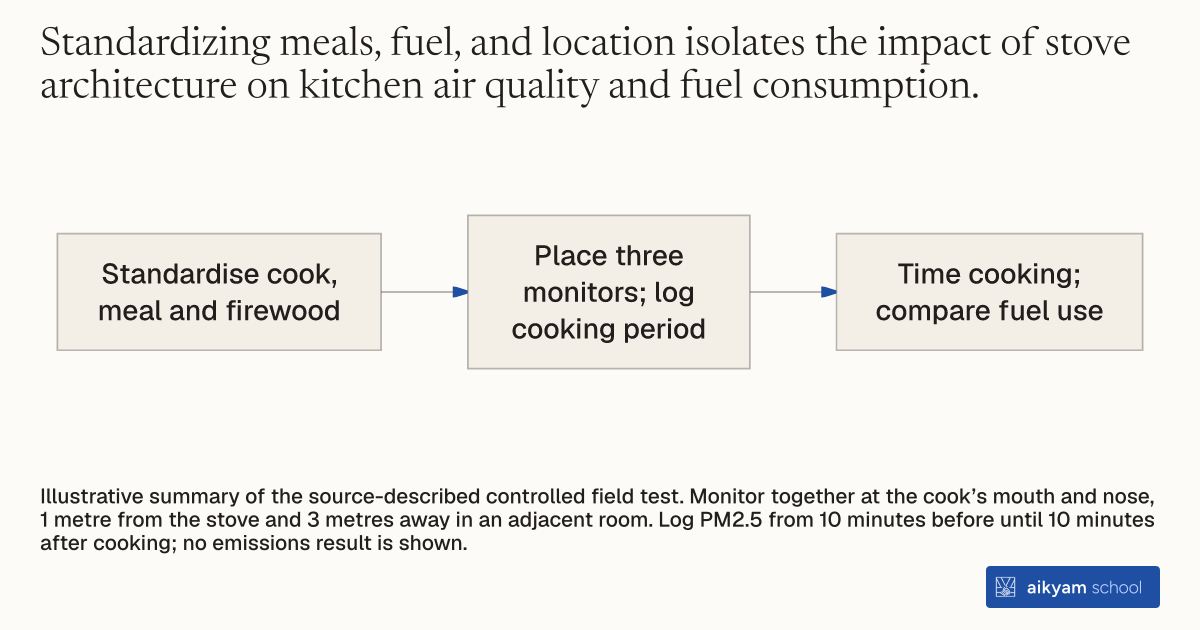
Research procedure
Measure cooking pollution and fuel use
- Standardise cook, meal and firewood
- Place three monitors; log cooking period
- Time cooking; compare fuel use
Illustrative summary of the source-described controlled field test. Monitor together at the cook’s mouth and nose, 1 metre from the stove and 3 metres away in an adjacent room. Log PM2.5 from 10 minutes before until 10 minutes after cooking; no emissions result is shown.
See source →How
When to use
Development organizations need to verify claims about household energy technologies before marketing them to rural consumers. Standard laboratory metrics often fail to reflect actual performance in real domestic environments. This method measures real-world smoke pollution and fuel consumption under controlled household cooking conditions.
Test cookstoves under controlled field conditions to measure particulate matter emissions and fuel usage.
- Instruct the same cook to prepare a standardized meal of rice and vegetables using identical firewood fuel.
- Position three aerosol monitors to log PM2.5 levels ten minutes before cooking, during cooking, and ten minutes after cooking.
- Attach one monitor to the cook's body with an input tube placed near the mouth and nose.
- Place a second monitor inside the kitchen one meter from the stove and a third monitor three meters away in an adjacent room.
- Record cooking duration with a stopwatch and calculate fuel consumption against traditional cookstoves.
Why it works
Personal and stationary monitors capture both personal exposure for cooks and broader household pollution dissipation.
Example
Researchers tested traditional, efficiency, and chimney stoves across 54 traditional stove cooking episodes and 61 chimney stove cooking episodes in rural Bangladesh. Efficiency stoves reduced fuel use by 20-25% but did not lower PM2.5 emissions (0.96 mg/m3 compared to 0.95 mg/m3). Chimney stoves reduced kitchen PM2.5 concentrations by 17% and reduced personal exposure for cooks by 47% (from 1.20 mg/m3 to 0.626 mg/m3).
About the study
Participants
115 total cooking test episodes (54 traditional stove episodes and 61 chimney stove episodes) in rural Bangladesh.
Study Design
Controlled field experiment standardizing cook, meal type, room, and firewood fuel while measuring PM2.5 concentrations with three SidePack monitors attached to the cook, at 1 meter, and at 3 meters over the cooking duration.
Results
Efficiency stoves reduced fuel use by 20-25% without altering PM2.5 emissions (0.96 mg/m3 vs 0.95 mg/m3 for traditional stoves). Chimney stoves reduced kitchen PM2.5 by 17% (p=0.16) and reduced cook personal exposure by 47% (from 1.20 mg/m3 to 0.626 mg/m3, p=0.007).