Research procedure
Test stoves before and after adoption
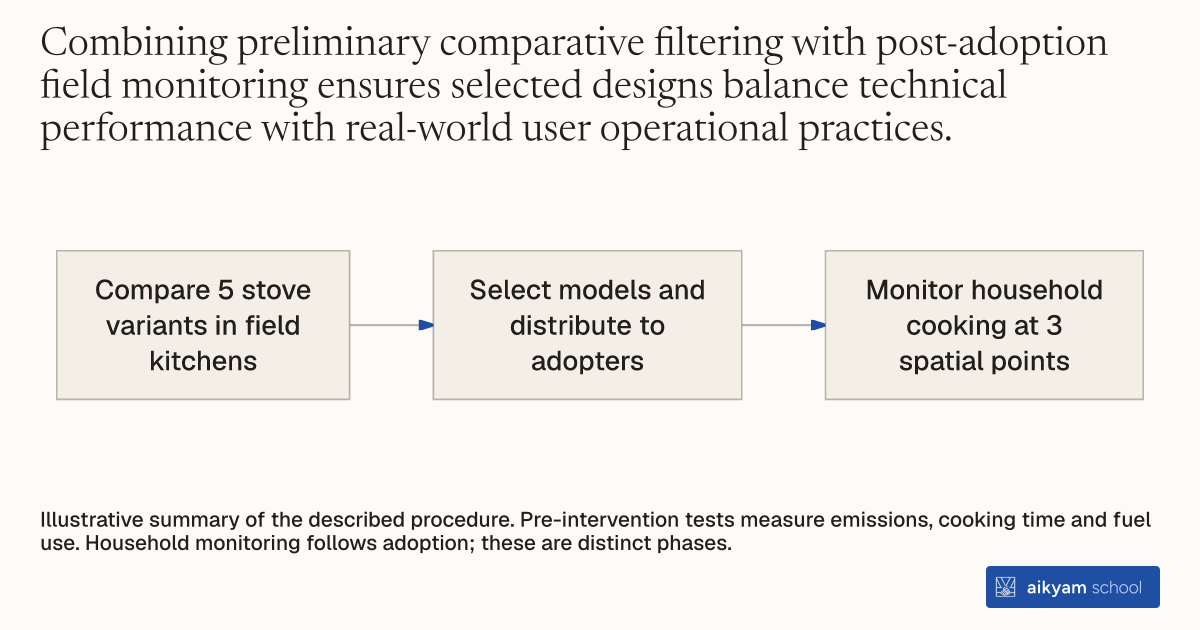
- Compare 5 stove variants in field kitchens
- Select models and distribute to adopters
- Monitor household cooking at 3 spatial points
Illustrative summary of the described procedure. Pre-intervention tests measure emissions, cooking time and fuel use. Household monitoring follows adoption; these are distinct phases.
See source →How
When to use
Engineers and researchers need to select optimal technology models before launching large-scale community interventions. Laboratory-only measurements fail to capture actual performance and user cooking behavior in field kitchen environments. This method provides a structured two-stage testing protocol to evaluate fuel efficiency, cooking speed, and smoke emissions under realistic cooking conditions.
Evaluate candidate cookstove designs by conducting pre-intervention laboratory-in-field comparative tests followed by post-intervention real-world kitchen monitoring.
- Select 5 candidate cookstove variants including traditional single-pot, portable single-pot with and without grates, and double-pot chimney stoves with and without grates.
- Position Side Pack PM 2.5μ monitors in controlled field kitchens to record continuous particulate emissions, cooking duration, and fuel mass consumed per cooking session.
- Compare pre-intervention performance to select top-performing models for community marketing distribution.
- Deploy the selected stove designs to community adopters.
- Conduct a second monitoring phase measuring emissions at 3 spatial points during regular household meal preparation.
Example
Researchers in Bangladesh tested 5 stove variations using Side Pack PM 2.5μ machines, finding grates reduced portable stove cooking time by 20 percent, leading to the selection of GTZ and Practical Action models.
About the study
Participants
5 cookstove variations in initial controlled kitchen tests and follow-up monitoring of adopter households in Jamalpur Sadar and Hatia, Bangladesh.
Study Design
Controlled kitchen testing evaluating PM2.5 emissions, fuel efficiency, and cooking time across 5 stove configurations, followed by 3-point spatial emission monitoring in adopters' homes.
Results
Chimney stoves reduced smoke emissions but did not decrease fuel use or cooking time, portable stoves reduced fuel use without lowering per-unit emission rates, and adding a grate to portable stoves reduced cooking time by 20 percent.