Research design
Measure cooking pollution simultaneously
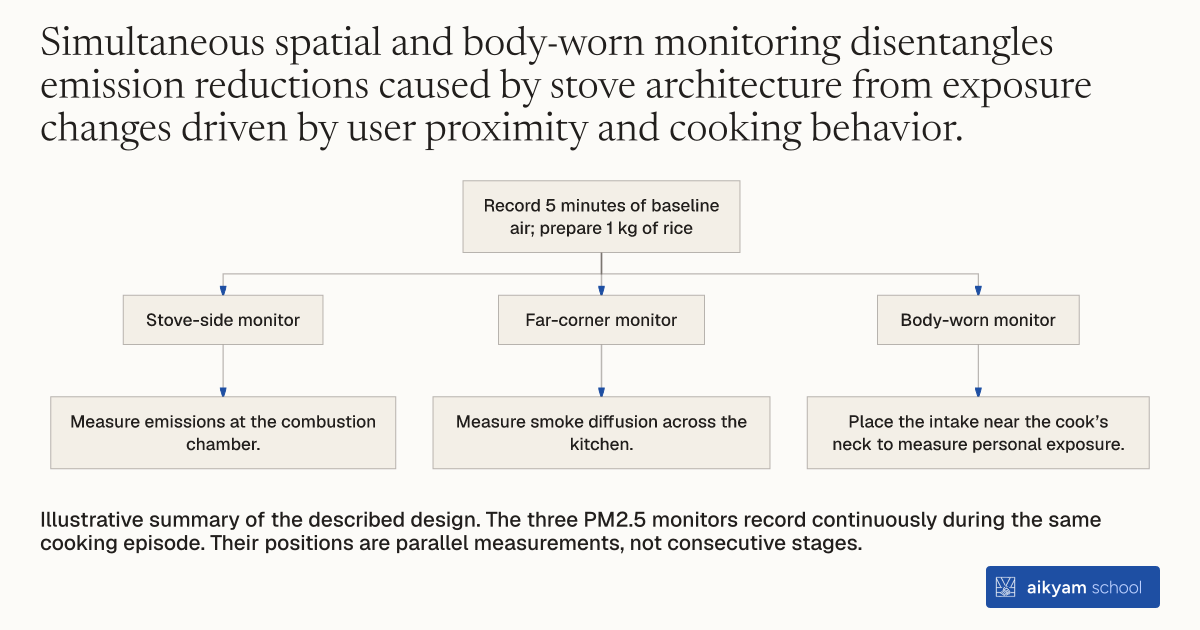
Record 5 minutes of baseline air; prepare 1 kg of rice
- Stove-side monitor
- Measure emissions at the combustion chamber.
- Far-corner monitor
- Measure smoke diffusion across the kitchen.
- Body-worn monitor
- Place the intake near the cook’s neck to measure personal exposure.
Illustrative summary of the described design. The three PM2.5 monitors record continuously during the same cooking episode. Their positions are parallel measurements, not consecutive stages.
See source →How
When to use
Environmental health researchers need to evaluate how household energy technologies affect actual human air pollution exposure during daily cooking. Measuring smoke solely at the stove point misses how indoor air diffuses across the kitchen and how user cooking behavior alters actual personal intake. This method provides a synchronized multi-point measurement protocol to capture point-of-combustion, room diffusion, and personal exposure levels.
Measure indoor air pollution exposure during standard meal preparation by deploying three synchronized continuous PM2.5 monitors across spatial and personal locations.
- Instruct the primary household cook to prepare a standardized 1 kilogram rice meal in their normal kitchen environment.
- Run a PM2.5 monitor inside the kitchen for 5 minutes prior to cooking to establish baseline ambient particulate levels.
- Position one monitor directly adjacent to the stove combustion chamber to record point-of-origin emissions.
- Position a second monitor in the kitchen corner furthest from the stove to measure room-wide smoke diffusion.
- Affix a third monitor to a sash on the cook's body with an air intake tube positioned near the neck to measure direct personal breathing exposure.
Why it works
Capturing baseline air quality before cooking controls for ambient background pollution.
Example
Researchers in rural Bangladesh conducted 216 real-time emission tests during 1 kg rice cooking episodes across closed, semi-closed, and open kitchens to measure cook exposure versus point-of-origin pollution.
About the study
Participants
216 emission tests conducted with primary household cooks across closed, semi-closed, and open kitchen environments in Jamalpur Sadar and Hatia, Bangladesh.
Study Design
Controlled field measurement protocol using 3 synchronized continuous PM2.5 real-time monitors (stove-side, far corner, body-worn sash) across 3 kitchen ventilation types during 1 kg rice preparation.
Results
High-precision real-time tracking across 216 tests separated stove-level emission performance from behavioral proximity factors, isolating true human exposure changes from spatial room diffusion across open, semi-closed, and closed kitchens.