Research design
Interview spouses separately
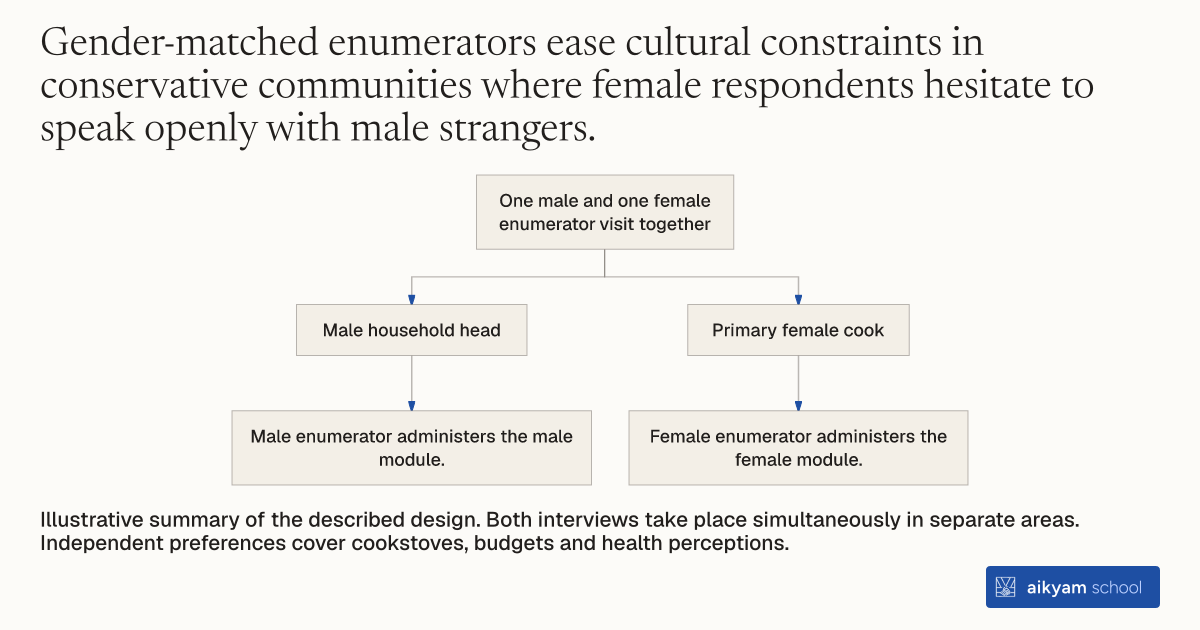
One male and one female enumerator visit together
- Male household head
- Male enumerator administers the male module.
- Primary female cook
- Female enumerator administers the female module.
Illustrative summary of the described design. Both interviews take place simultaneously in separate areas. Independent preferences cover cookstoves, budgets and health perceptions.
See source →How
When to use
Researchers need to collect intra-household decision-making data without spousal influence or reporting bias. In conservative rural settings, male interviewers face cultural barriers interviewing female respondents alone, while unseparated spouses suppress divergent preferences. This method deploys gender-matched two-person enumerator teams to conduct simultaneous, physically separate interviews with husbands and wives.
Administer intra-household surveys by deploying gender-paired enumerators to conduct simultaneous, physically independent interviews with male and female spouses.
- Form two-person enumerator teams consisting of one male interviewer and one female interviewer.
- Visit target households together and divide the quantitative questionnaire into dedicated male and female modules.
- Assign the male enumerator to interview the male household head while the female enumerator interviews the primary female cook separately.
- Conduct the two spousal interviews simultaneously in separate areas of the household premises to prevent mutual influence.
- Record independent spousal preferences regarding cookstove adoption, budget allocations, and health perceptions.
Why it works
Simultaneous separate interviewing prevents joint spousal consensus-building and eliminates reporting bias during preference elicitation.
Example
Researchers deployed 30 two-person male-female enumerator teams across Jamalpur Sadar and Hatia in Bangladesh to conduct separate interviews with husbands and wives across 3,080 households.
About the study
Participants
3,080 households across 58 rural villages in Jamalpur Sadar and Hatia upazilas, Bangladesh.
Study Design
Dual-enumerator paired interviewing protocol deploying 30 male-female teams across 58 villages to conduct simultaneous, gender-separated spousal surveys.
Results
30 enumerator pairs completed 3,080 simultaneous dual-gender questionnaires at a minimum target rate of 4 completed household surveys per team per day without spousal interference.