Research procedure
Survey cooking practices and spending priorities
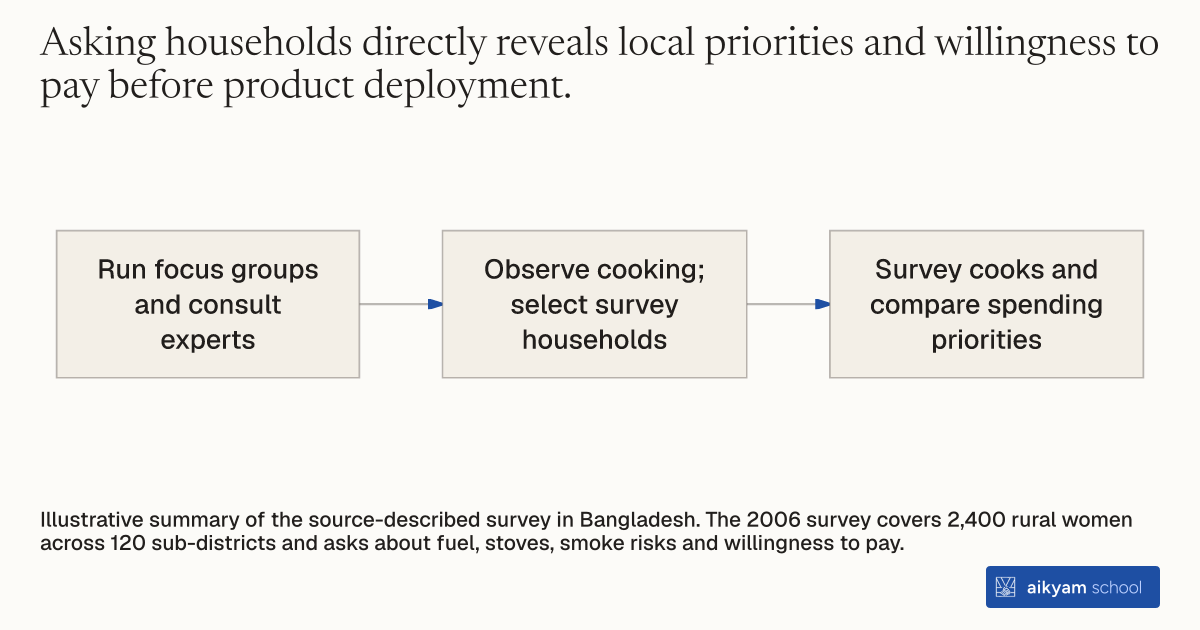
- Run focus groups and consult experts
- Observe cooking; select survey households
- Survey cooks and compare spending priorities
Illustrative summary of the source-described survey in Bangladesh. The 2006 survey covers 2,400 rural women across 120 sub-districts and asks about fuel, stoves, smoke risks and willingness to pay.
See source →How
When to use
Rural communities rely on traditional technology with hidden health and environmental costs. Program managers need to measure existing household habits and public awareness of risks. This method evaluates community knowledge and willingness to pay before launching a technology intervention.
Conduct a structured household survey to evaluate cooking practices and willingness to pay for improved technology.
- Run qualitative focus groups with rural women and consult local energy experts to identify key household cooking issues.
- Direct enumerators to conduct observational visits during active household cooking episodes.
- Select a nationally representative sample across 120 rural sub-districts.
- Survey female primary cooks on current fuel choices, stove types, and perceived health risks of indoor air pollution.
- Administer a contingent valuation questionnaire comparing improved cookstoves against twelve other basic household goods and services.
Why it works
This prevents misallocating development resources toward products that households value far lower than other daily needs.
Example
Researchers surveyed 2400 rural women across 120 sub-districts in Bangladesh in 2006. The survey found that 99% used traditional stoves and 94% knew smoke was harmful. However, cookstoves ranked at the bottom of twelve household spending priorities.
About the study
Participants
2400 rural women across 120 sub-districts of Bangladesh.
Study Design
Nationally representative household survey combining qualitative focus groups, direct observation of cooking episodes, structured questionnaires, and contingent valuation ranking.
Results
Traditional stove usage was 99% and improved cookstove awareness was 12%, while 94% recognized smoke harms health. Improved cookstoves ranked lowest among twelve basic household expenditure options in contingent valuation comparisons.