Try, learn and adjust
Check tailored support reaches a vulnerable mother
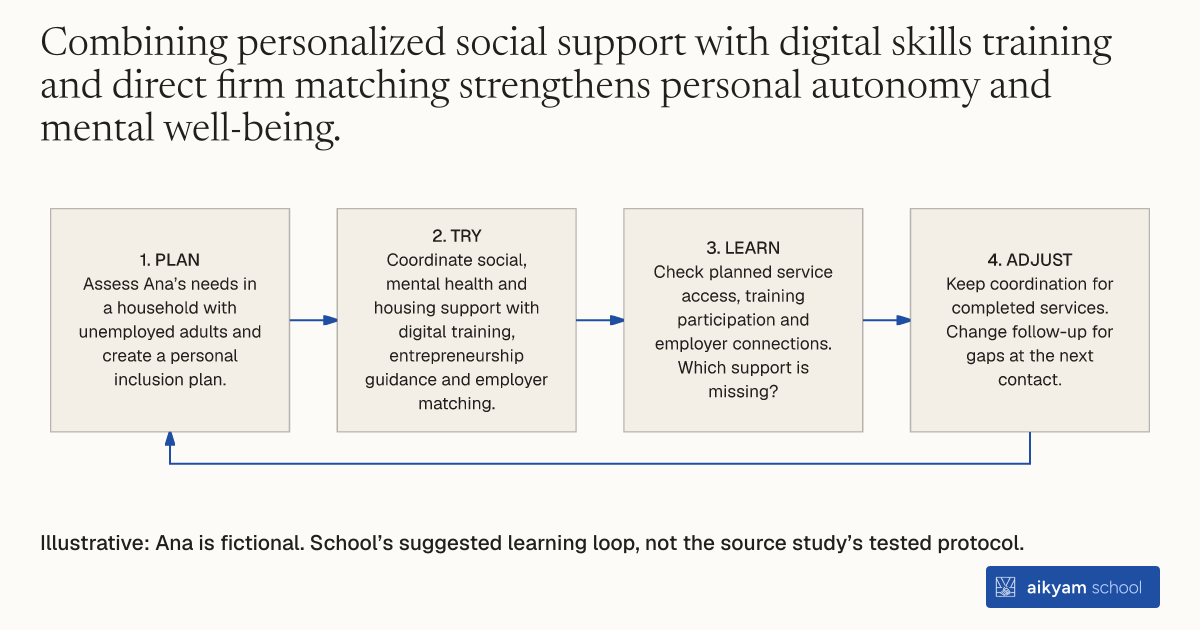
- Plan: Assess Ana’s needs in a household with unemployed adults and create a personal inclusion plan.
- Try: Coordinate social, mental health and housing support with digital training, entrepreneurship guidance and employer matching.
- Learn: Check planned service access, training participation and employer connections. Which support is missing?
- Adjust: Keep coordination for completed services. Change follow-up for gaps at the next contact.
Illustrative: Ana is fictional. School’s suggested learning loop, not the source study’s tested protocol.
See source →School’s suggested, untested loop: observe service access. Survey employment gains were not confirmed in administrative records; endline survey response was 46%.
How
When to use
Mothers in low-income households with unemployed adults face severe barriers to workforce re-entry, including primary caregiving responsibilities and digital exclusion. Standard individual employment services often fail to address personal autonomy and housing needs alongside career guidance. This method provides mothers at risk of poverty with tailored social services, digital skills training, and firm-matching assistance.
Deliver tailored employment support and social services to vulnerable mothers through a municipal one-stop shop model.
- Specialized caseworkers perform an initial needs assessment for mothers in households with unemployed adults.
- Caseworkers design personalized inclusion plans providing targeted social assistance, mental health support, and housing guidance.
- Instructors deliver specialized training in digital skills, self-employment, and entrepreneurship.
- Employment staff conduct job search assistance and facilitate matching activities with local hiring businesses.
Why it works
Addressing household stability and self-confidence alongside job search skills helps mothers navigate the labor market more effectively.
Example
The Government of Castilla-La Mancha in Spain implemented a one-stop shop model across 92 municipalities for 1,652 mothers at risk of poverty in unemployed households. Specialized caseworkers delivered personalized plans, digital skills training, and firm-matching assistance over ten months. Participating mothers achieved higher job search skills, professional competencies, personal autonomy, life satisfaction, mental health, housing conditions, and overall social inclusion.
About the study
Participants
1,652 mothers at risk of poverty or social exclusion in households where adults were unemployed (826 treatment group, 826 comparison group) across 92 municipalities in Castilla-La Mancha, Spain.
Study Design
Cluster Randomised Controlled Trial (RCT) evaluating a 10-month one-stop shop model implemented by the social services of the Government of Castilla-La Mancha.
Results
The program increased participants' job search skills, professional competencies, personal autonomy, life satisfaction, mental health, housing conditions, social interactions, and overall social inclusion, with survey data showing higher employment probability (though administrative records showed no employment impact and endline survey response was 46 percent).