Try, learn and adjust
Check job search support reaches employers
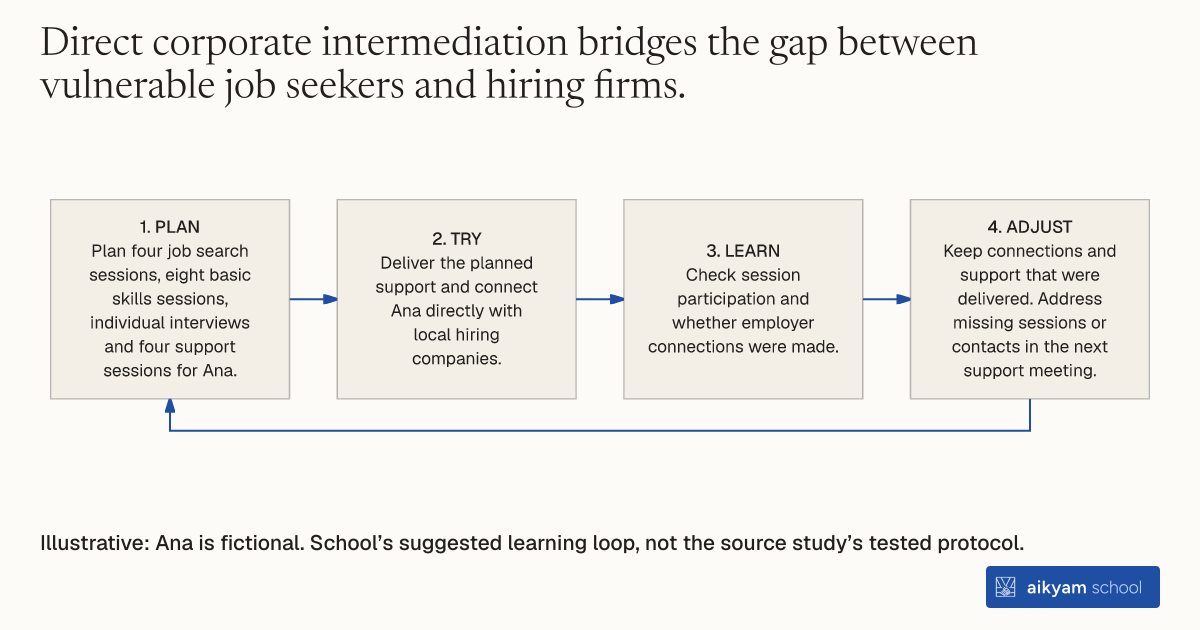
- Plan: Plan four job search sessions, eight basic skills sessions, individual interviews and four support sessions for Ana.
- Try: Deliver the planned support and connect Ana directly with local hiring companies.
- Learn: Check session participation and whether employer connections were made.
- Adjust: Keep connections and support that were delivered. Address missing sessions or contacts in the next support meeting.
Illustrative: Ana is fictional. School’s suggested learning loop, not the source study’s tested protocol.
See source →School’s suggested, untested loop: observe training participation and company connections; the trial found no improvement in overall job search intensity.
How
When to use
Working-age job seekers at risk of poverty face barriers securing formal employment when relying solely on unassisted job searches. Standard basic job search workshops often fail to connect vulnerable job seekers directly to hiring firms. This method pairs direct corporate intermediation with basic skills and job search instruction to help vulnerable job seekers secure formal employment contracts.
Combine active job search training, basic skills instruction, and direct corporate intermediation for job seekers at risk of poverty.
- Employment advisors deliver four specialized training sessions on active job search techniques.
- Instructors conduct eight training sessions covering foundational basic skills for workplace readiness.
- Caseworkers hold individual interviews and four job search support sessions with participants.
- Program staff perform direct corporate intermediation activities to connect job seekers with local hiring companies.
Why it works
Active employer matching helps formalise employment by encouraging companies to issue standard job contracts.
Example
Cáritas implemented a job placement program across eleven Spanish provinces targeting 2,364 working-age individuals at risk of poverty or social exclusion. Participants assigned to Treatment 1 received four job search sessions, eight basic skills sessions, individual interviews, and four support sessions with corporate intermediation. The intervention reduced the proportion of participants working without a short-term contract, promoting formalisation of employment.
About the study
Participants
2,364 working-age individuals at risk of poverty or social exclusion across 11 Spanish provinces (656 in Treatment 1, 653 in Treatment 2, 1,055 in comparison group).
Study Design
Randomised Controlled Trial (RCT) evaluating a 9-month job placement intervention implemented by Cáritas across eleven Spanish provinces.
Results
Treatment 1 reduced the proportion of participants working without a short-term contract (suggesting positive effects on employment formalisation), but showed a negative effect on the number of people working in the medium term, while having no impact on overall job search intensity or recruitment process participation.