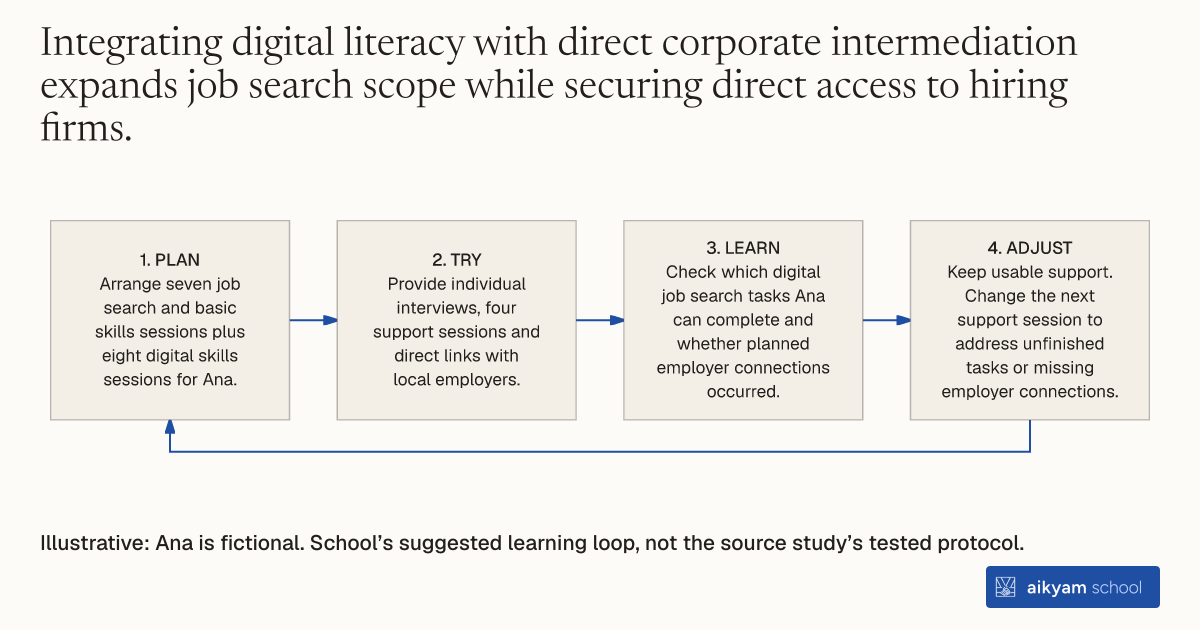
Try, learn and adjust
Check digital and job search support are combined
- Plan: Arrange seven job search and basic skills sessions plus eight digital skills sessions for Ana.
- Try: Provide individual interviews, four support sessions and direct links with local employers.
- Learn: Check which digital job search tasks Ana can complete and whether planned employer connections occurred.
- Adjust: Keep usable support. Change the next support session to address unfinished tasks or missing employer connections.
Illustrative: Ana is fictional. School’s suggested learning loop, not the source study’s tested protocol.
See source →School’s suggested, untested loop: observe training, individual support and employer connections; the study evaluates the combined package.
How
When to use
Working-age job seekers at risk of poverty face low employment quality and frequent defaults on credit obligations when using basic job search strategies. Simple job search instruction without digital tools or active business matching fails to secure stable full-time employment. This method combines corporate intermediation with digital skills workshops to improve full-time employment rates and household financial stability.
Combine active job search training, corporate intermediation, basic skills, and dedicated digital skills sessions for low-income job seekers.
- Employment advisors deliver seven training sessions on active job search techniques and basic workplace skills.
- Instructors deliver eight dedicated digital skills training sessions covering digital job search tools and online basic tasks.
- Caseworkers conduct individual interviews and four support sessions to refine participants' career plans.
- Program liaisons engage in direct corporate intermediation to connect job seekers with local hiring managers.
Why it works
Improving access to quality full-time employment reduces financial distress and loan default rates among vulnerable households.
Example
Cáritas implemented Treatment 2 of the Emplealab project across eleven Spanish provinces for 2,364 working-age individuals at risk of poverty or social exclusion. Participants received active job search training, corporate intermediation, basic skills workshops, and eight digital skills sessions over nine months. The program significantly increased full-time employment probability, full-time days worked, and employment intensity, while decreasing participant loan default rates.
About the study
Participants
2,364 working-age individuals at risk of poverty across 11 Spanish provinces (656 in Treatment 1, 653 in Treatment 2, 1,055 in comparison group).
Study Design
Randomised Controlled Trial (RCT) evaluating a 9-month job placement intervention implemented by Cáritas across eleven Spanish provinces.
Results
Treatment 2 improved employment conditions, increasing the probability of full-time employment, the number of full-time days worked, and employment intensity, while increasing the likelihood of participants not defaulting on a loan, though impacts on basic online tasks were short-lived.