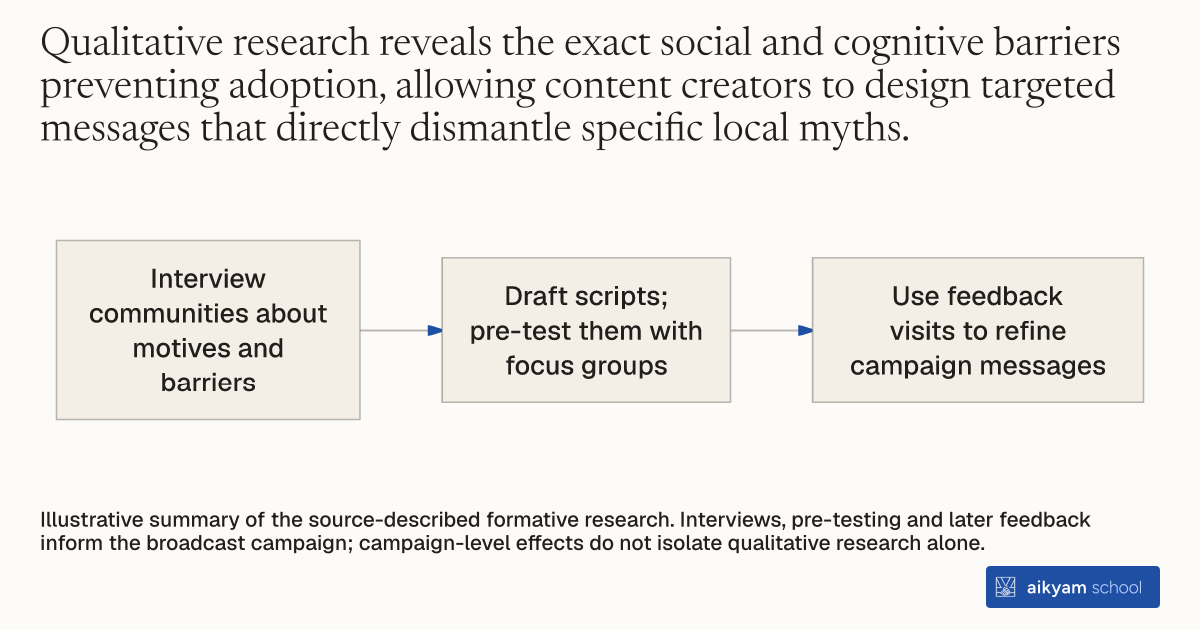
Research steps
Research barriers before shaping messages
- Interview communities about motives and barriers
- Draft scripts; pre-test them with focus groups
- Use feedback visits to refine campaign messages
Illustrative summary of the source-described formative research. Interviews, pre-testing and later feedback inform the broadcast campaign; campaign-level effects do not isolate qualitative research alone.
See source →How
When to use
Before designing a mass media or public health behavior change campaign, program planners need to identify specific community misconceptions and social barriers. Standard health messages often fail because they repeat basic logistics rather than addressing underlying fears such as permanent sterility or marital conflict. Conducting structured qualitative research in target communities uncovers real audience motivations and information gaps.
Conduct iterative qualitative research across target communities to identify local barriers, pre-test messaging, and ground campaign narratives in audience realities.
- Deploy research teams to conduct field interviews and focus discussions in target rural villages.
- Map audience motivations, values, and specific misconceptions regarding available health technologies like implants, injectables, pills, and condoms.
- Identify core behavioral obstacles, such as fear of side effects, concerns about infertility, and social norms around partner consent.
- Draft broadcast scripts and storyline concepts focused on overcoming these specific decision barriers.
- Pre-test draft audio scripts with focus groups in target communities to assess clarity, emotional impact, and resonance.
- Perform regular qualitative feedback visits to rural villages throughout campaign implementation to refine ongoing messaging.
Why it works
Pre-testing and continuous audience feedback ensure that campaign scripts remain relatable and emotionally engaging over time.
Example
In Burkina Faso, Development Media International conducted formative qualitative research in rural villages to inform a 2.5-year radio campaign. Researchers identified key barriers including fear of sterility, concerns about side effects, lack of method knowledge, and restrictive gender norms. These insights shaped 90-second spots and interactive shows targeting 5.1 million listeners across 8 radio station zones.
About the study
Participants
Target audience covering 5.1 million rural inhabitants across 8 radio broadcast zones in Burkina Faso.
Study Design
Qualitative formative research, pre-testing focus groups, and feedback visits integrated into a clustered randomized controlled trial.
Results
Designing campaign content around formative research findings reduced sterility misperceptions by 9 percentage points (a 35 percent drop) and increased modern contraceptive prevalence by 5.9 percentage points.