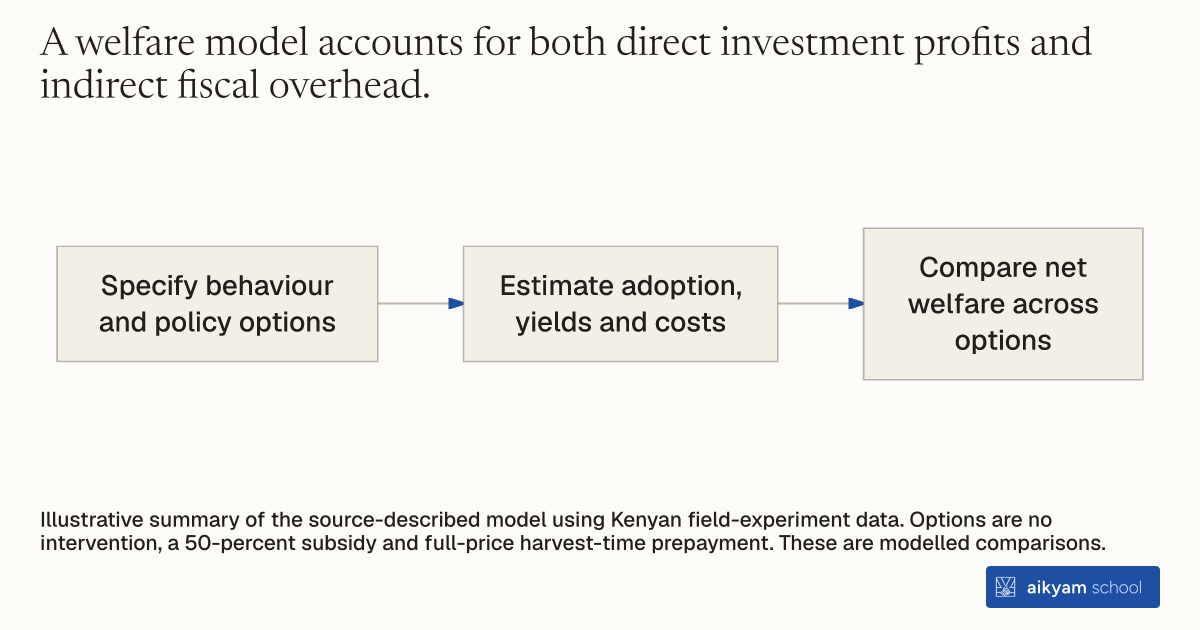
Research steps
Compare modelled policy welfare
- Specify behaviour and policy options
- Estimate adoption, yields and costs
- Compare net welfare across options
Illustrative summary of the source-described model using Kenyan field-experiment data. Options are no intervention, a 50-percent subsidy and full-price harvest-time prepayment. These are modelled comparisons.
See source →How
When to use
Policymakers struggle to choose between broad input subsidies, targeted behavioral nudges, and non-intervention. Heavy price subsidies create large fiscal costs, promote environmental overuse, and disproportionately benefit wealthier farmers. This method estimates net societal gains across alternative policy scenarios to guide effective agricultural policy design.
Build an economic model comparing total societal welfare across competing input policy regimes.
- Specify behavioral decision parameters that capture farmer time inconsistency, cash constraints, and input returns.
- Define policy scenarios including no intervention, heavy price subsidies, and full-price harvest-time prepayment nudges.
- Estimate predicted input adoption rates and crop yield increases for each policy scenario using field experiment data.
- Calculate total public expenditure, fiscal overhead, and market distortion costs required by each intervention option.
- Sum farmer profit gains and public expenditure costs to determine which policy option generates the highest net social welfare.
Why it works
It proves whether small behavioral nudges achieve similar welfare improvements as expensive subsidies without placing financial burdens on public budgets.
Example
Researchers built an economic welfare model using field experiment data from subsistence maize farmers in Busia district, Kenya, finding that a SAFI-style prepayment nudge improved overall social welfare relative to no intervention and provided higher net welfare gains than a 50-percent price subsidy.
About the study
Participants
Subsistence maize farmers in Busia district, western Kenya, where baseline fertilizer adoption was 29 percent and annualized returns ranged from 52 to 85 percent.
Study Design
Structural economic welfare modeling calibrated with data from a randomized controlled trial comparing a 50-percent price subsidy against full-price harvest-time prepayment offers.
Results
The economic model showed that a SAFI-style nudge improves overall welfare over no policy action, while delivering equal or larger net welfare gains than a 50-percent price subsidy by avoiding government fiscal spending and overuse distortions.