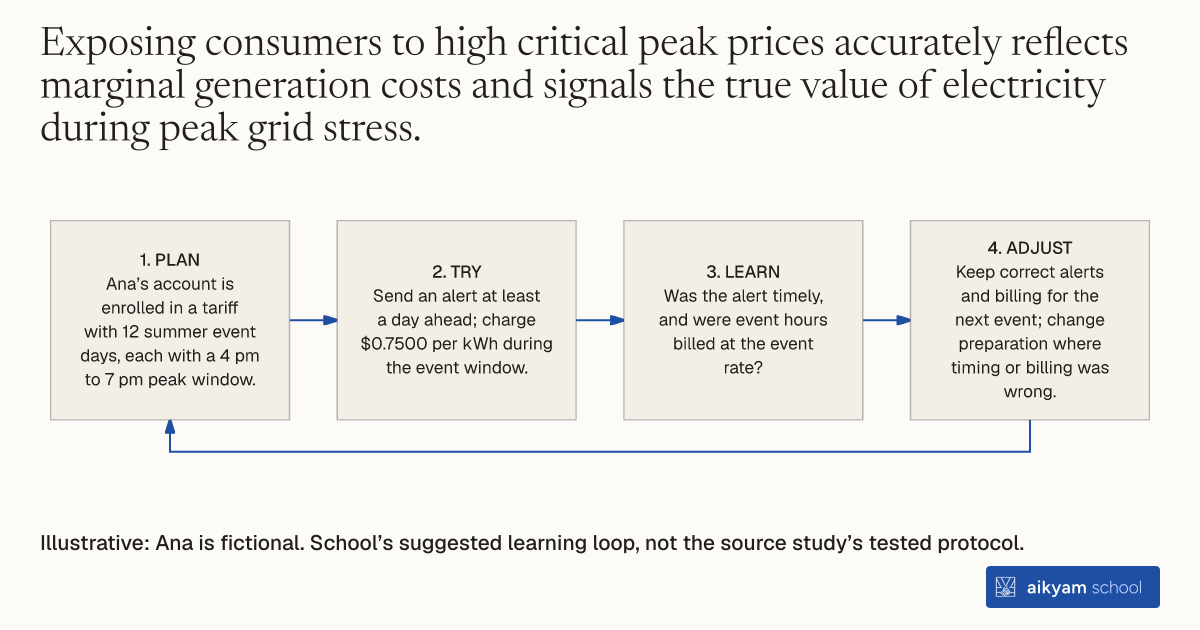
Try, learn and adjust
Check critical peak alerts and billing
- Plan: Ana’s account is enrolled in a tariff with 12 summer event days, each with a 4 pm to 7 pm peak window.
- Try: Send an alert at least a day ahead; charge $0.7500 per kWh during the event window.
- Learn: Was the alert timely, and were event hours billed at the event rate?
- Adjust: Keep correct alerts and billing for the next event; change preparation where timing or billing was wrong.
Illustrative: Ana is fictional. School’s suggested learning loop, not the source study’s tested protocol.
See source →School’s suggested learning loop, not a tested source procedure. Observe alerts, event-hour use and billing. Events fall on weekdays from 1 June to 30 September; off-event tiers and the $10 monthly charge also apply.
How
When to use
Public electric utilities face extreme wholesale price spikes and high capacity expansion costs during peak demand hours in summer. Standard flat retail rates fail to reflect dynamic marginal costs, causing over-consumption during peak periods. Critical peak pricing schedules expose residential consumers to targeted surge prices during top grid load days to encourage load shifting.
Structure dynamic electricity tariffs using critical peak pricing to incentivize demand reductions during extreme wholesale price spikes.
- Program managers set a high-price event rate of \$0.7500 per kWh for peak consumption hours between 4 PM and 7 PM on weekdays from June 1 through September 30.
- Operations staff designate 12 critical event days per summer during the highest demand weekdays.
- Communications staff send event alerts to enrolled residential households at least one day in advance of each critical peak event.
- Billing staff charge a reduced off-event rate of \$0.0851 per kWh for the first 700 kWh and \$0.1665 per kWh for usage above 700 kWh during all non-event hours.
- Utility administrators maintain a \$10 monthly fixed customer charge to keep the rate structure revenue neutral under baseline usage.
Why it works
Advanced day-ahead alerts increase price salience, enabling households to make deliberate load adjustments during event windows.
Example
SMUD implemented a Critical Peak Pricing tariff for residential customers in Sacramento, California during the summers of 2012 and 2013, charging \$0.75 per kWh during 12 event days from 4 PM to 7 PM, which reduced peak electricity consumption by 0.658 kW per household among active opt-in joiners and 0.242 kW among passive opt-out enrollees.
About the study
Participants
55,028 opt-in and 46,684 opt-out residential customer-hours in Sacramento, California.
Study Design
Randomized controlled trial comparing CPP opt-in encouragement and default opt-out enrollment against a standard rate control group.
Results
CPP enrollment reduced average critical peak electricity usage by 0.658 kW per household among active opt-in joiners (p < 0.01) and 0.242 kW among passive opt-out enrollees (p < 0.01), lowering average monthly summer bills by \$6.52 and \$3.12 respectively.