Research steps
Sample farmers by crop district
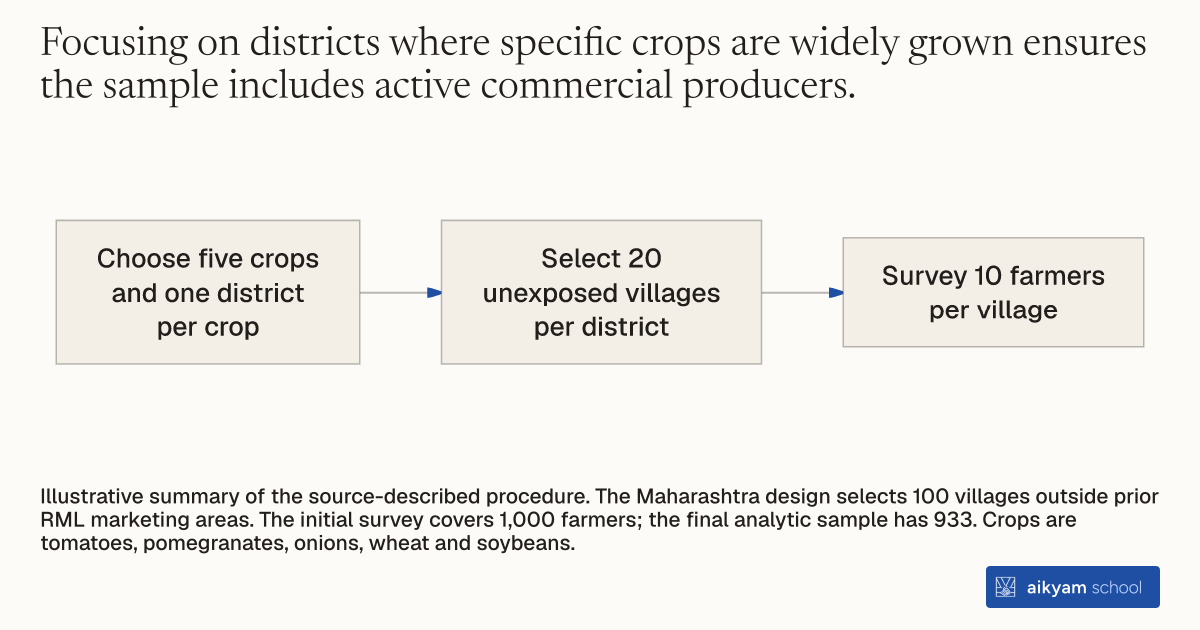
- Choose five crops and one district per crop
- Select 20 unexposed villages per district
- Survey 10 farmers per village
Illustrative summary of the source-described procedure. The Maharashtra design selects 100 villages outside prior RML marketing areas. The initial survey covers 1,000 farmers; the final analytic sample has 933. Crops are tomatoes, pomegranates, onions, wheat and soybeans.
See source →How
When to use
Researchers need to select representative smallholder farmers across diverse regional crops to test a new information service. Existing marketing campaigns can skew sample responses if participants already know the product. Selecting unexposed villages across major crop districts creates a clean baseline sample.
Select target survey locations and smallholder farmers using a structured multi-crop geographic sampling procedure.
- Identify major cash crops produced by smallholder farmers in the study region, selecting five target crops.
- Select one district for each crop where that crop is widely cultivated for sale.
- Choose 20 villages in each district located outside previous product marketing areas, totaling 100 villages.
- Select 10 smallholder farmers in each village to participate in baseline surveying, creating a sample of 1,000 farmers.
Why it works
Excluding areas with prior marketing exposure prevents existing product familiarity from biasing baseline measurements.
Example
Researchers in central Maharashtra, India selected five target crops: tomatoes, pomegranates, onions, wheat, and soybeans. They picked five districts where these crops were widely grown, chosen 20 unexposed villages per district, and surveyed 10 farmers per village to build an initial sample of 1,000 farmers across 100 villages.
About the study
Participants
933 farmers (from 1,000 initially surveyed) across 100 villages in 5 crop districts, central Maharashtra, India.
Study Design
Stratified cluster sampling across 5 major regional crops and 5 districts, selecting 20 villages per district in areas without prior RML marketing.
Results
Geographic cluster sampling created a panel of 1,000 farmers across 100 villages, yielding a final analytical sample of 933 farmers.