Research rollout
Assign households to three delivery waves
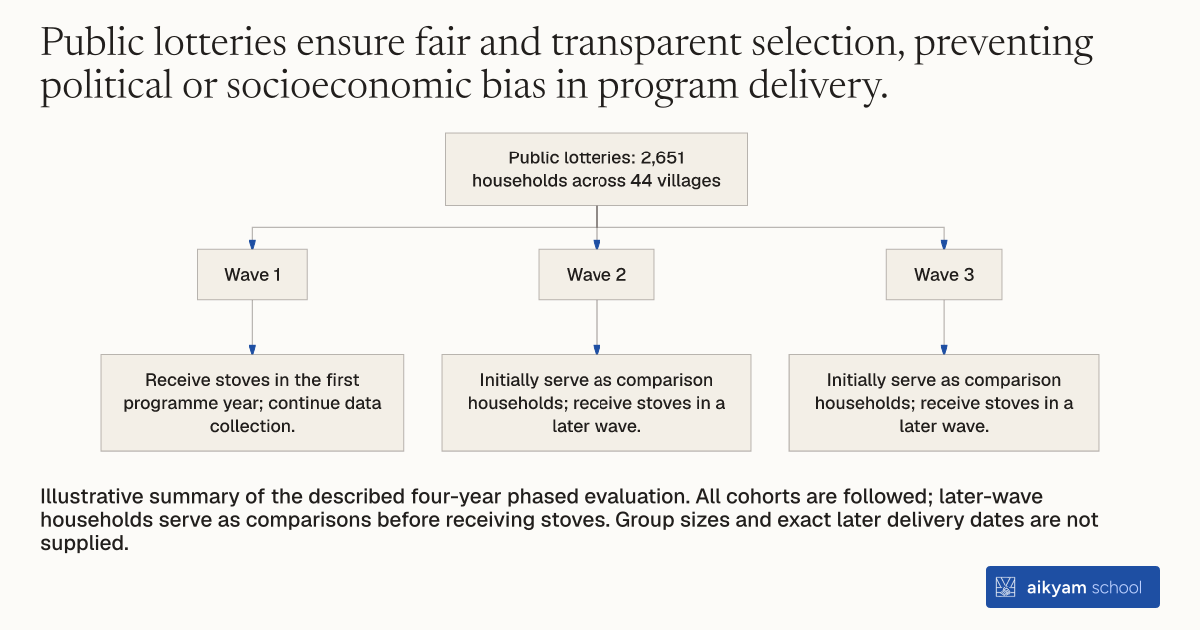
Public lotteries: 2,651 households across 44 villages
- Wave 1
- Receive stoves in the first programme year; continue data collection.
- Wave 2
- Initially serve as comparison households; receive stoves in a later wave.
- Wave 3
- Initially serve as comparison households; receive stoves in a later wave.
Illustrative summary of the described four-year phased evaluation. All cohorts are followed; later-wave households serve as comparisons before receiving stoves. Group sizes and exact later delivery dates are not supplied.
See source →How
When to use
Evaluating social or environmental programs across entire communities often faces ethical and logistical constraints against denying services to control groups. Implementing a public lottery to phase technology delivery in waves allows rigorous impact evaluation while ensuring all eligible households eventually receive the intervention.
Phase the distribution of a subsidized technology across target households using public lotteries.
- Define the total target population across participating villages and obtain community agreement for a staged rollout.
- Hold public lotteries in participating villages to randomly assign households into distinct rollout waves over a multi-year period.
- Distribute the intervention to Wave 1 households during the first program year while retaining Wave 2 and Wave 3 households as comparison groups.
- Roll out the intervention to subsequent wave groups in later years while continuing longitudinal data collection across all cohorts.
Why it works
Staggering distribution preserves valid comparison cohorts over multiple years without permanently withholding benefits from control families.
Example
Researchers held public lotteries across 44 villages in Orissa to assign 2,651 households to three delivery waves over four years, using later wave cohorts as comparison groups.
About the study
Participants
2,651 participating households across 44 villages in Orissa, India.
Study Design
Four-year randomized controlled trial using public lotteries to stagger stove construction across three wave cohorts.
Results
The phased lottery design allowed researchers to measure a 65 percentage point increase in stove ownership in years one and two, which declined to a 44 percentage point difference by year three.