Research procedure
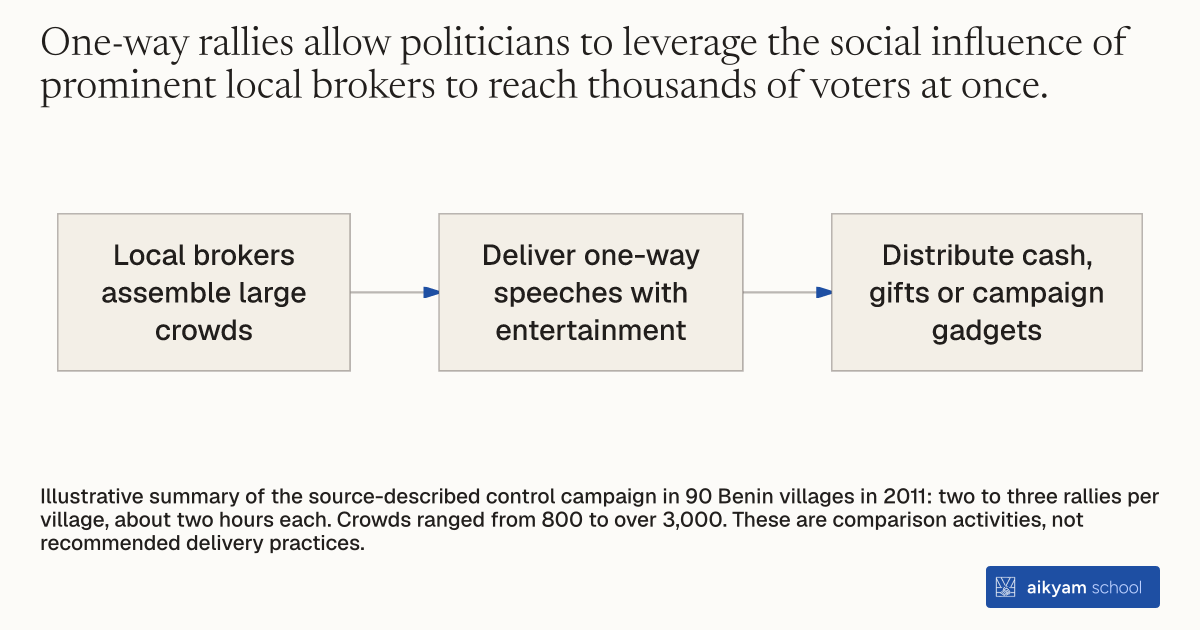
Describe broker-led comparison rallies
- Local brokers assemble large crowds
- Deliver one-way speeches with entertainment
- Distribute cash, gifts or campaign gadgets
Illustrative summary of the source-described control campaign in 90 Benin villages in 2011: two to three rallies per village, about two hours each. Crowds ranged from 800 to over 3,000. These are comparison activities, not recommended delivery practices.
See source →How
When to use
Traditional political campaigns in developing democracies often rely on political brokers to mobilize voters through mass rallies. This method describes the standard clientelist campaign strategy used as a control benchmark to evaluate policy-focused electoral alternatives. It engages large crowds using one-way speeches, entertainment, and material incentives.
Mobilize voters through large-scale political rallies managed by local political brokers and prominent figures.
- Deploy local political brokers, such as mayors or members of parliament, to organize campaign events across multiple villages.
- Gather large crowds ranging from 800 to over 3,000 villagers at a central rally location.
- Deliver one-way speeches by candidates or brokers outlining policy agendas and personal attributes without open voter debate.
- Provide a festive atmosphere featuring music, drinks, and celebration lasting approximately two hours.
- Distribute cash payments, gifts, or campaign gadgets to attendees to encourage turnout.
Why it works
Material gifts and entertainment provide immediate short-term benefits that motivate voter attendance.
Example
During the March 2011 presidential election campaign in Benin, local brokers organized two to three rallies per village across 90 control villages, attracting 800 to over 3,000 participants per rally at an estimated cost of at least \$15 per attendee, with 29.8% of surveyed voters receiving cash distribution.
About the study
Participants
90 control villages across 30 electoral districts in Benin, with representative household surveys covering 2,614 voters in control units.
Study Design
Randomized field experiment baseline control condition, comparing standard broker-led campaign rallies with cash and gadget distribution against deliberative town hall meetings without cash.
Results
Cash distribution reached 29.80% of control group respondents, but receiving cash showed no significant difference in voting for the incumbent party (t = 0.068) or opposition candidates (t = 2.58 in favor of non-receivers), with baseline village turnout averaging 85.5% in control areas.