Research design
Require consent from each spouse
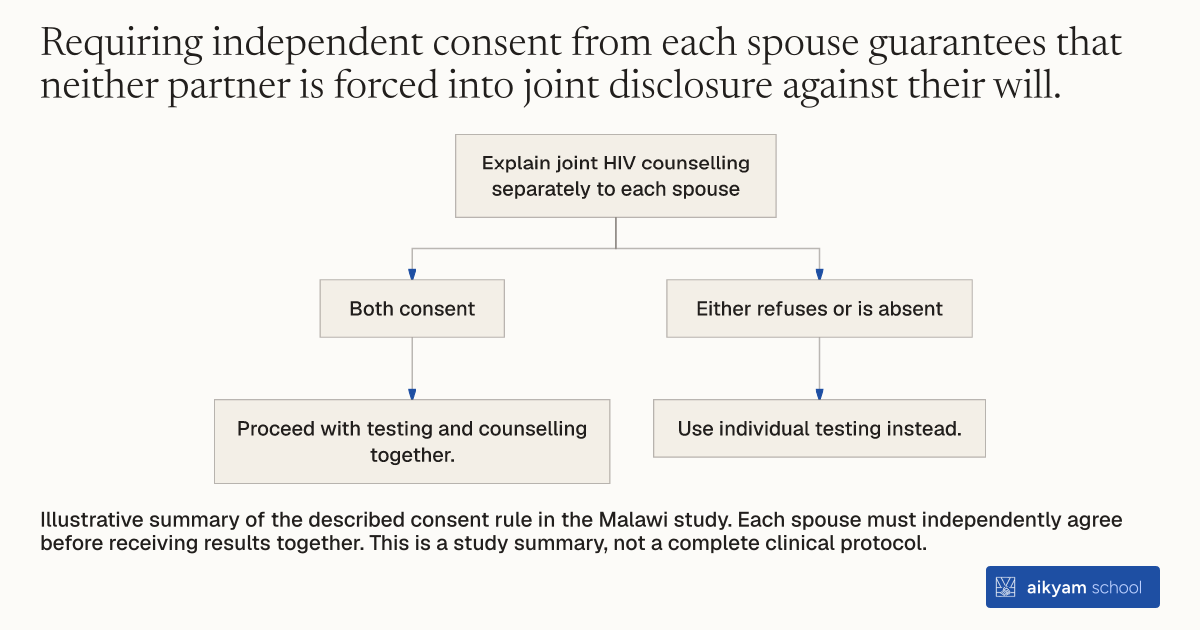
Explain joint HIV counselling separately to each spouse
- Both consent
- Proceed with testing and counselling together.
- Either refuses or is absent
- Use individual testing instead.
Illustrative summary of the described consent rule in the Malawi study. Each spouse must independently agree before receiving results together. This is a study summary, not a complete clinical protocol.
See source →How
When to use
Health programs offering joint spousal counseling face ethical challenges if one partner feels coerced into testing or sharing health results. Obtaining separate consent from each partner prevents coercion and protects individual autonomy. This approach ensures both married individuals freely agree before any joint counseling or testing takes place.
Require separate individual agreement from both spouses before enrolling a married couple into joint HIV counseling and testing.
- Field staff approach married respondents in their home villages to offer joint HIV testing and counseling options.
- Program staff interview each spouse separately to explain the joint counseling protocol.
- Health workers request voluntary informed consent from the husband independently.
- Health workers request voluntary informed consent from the wife independently.
- Field staff proceed with joint counseling only if both spouses individually agree to receive results together.
- Program staff administer individual testing if either spouse refuses joint counseling or if one spouse cannot be located.
Why it works
This maintains ethical standards while achieving high compliance among willing participants.
Example
Researchers implemented this protocol in rural Malawi with married survey respondents, resulting in 85 percent of offered couples successfully completing joint counseling.
About the study
Participants
1095 married individuals in rural Malawi, with an average age of almost 36 years and less than 1 year of formal education.
Study Design
A randomized field experiment requiring separate consent from each spouse before conducting joint HIV testing or falling back to individual testing.
Results
Approximately 85 percent of couples offered joint counseling individually agreed and received testing together, while 15 percent either refused or had an absent spouse and tested individually.