Research steps
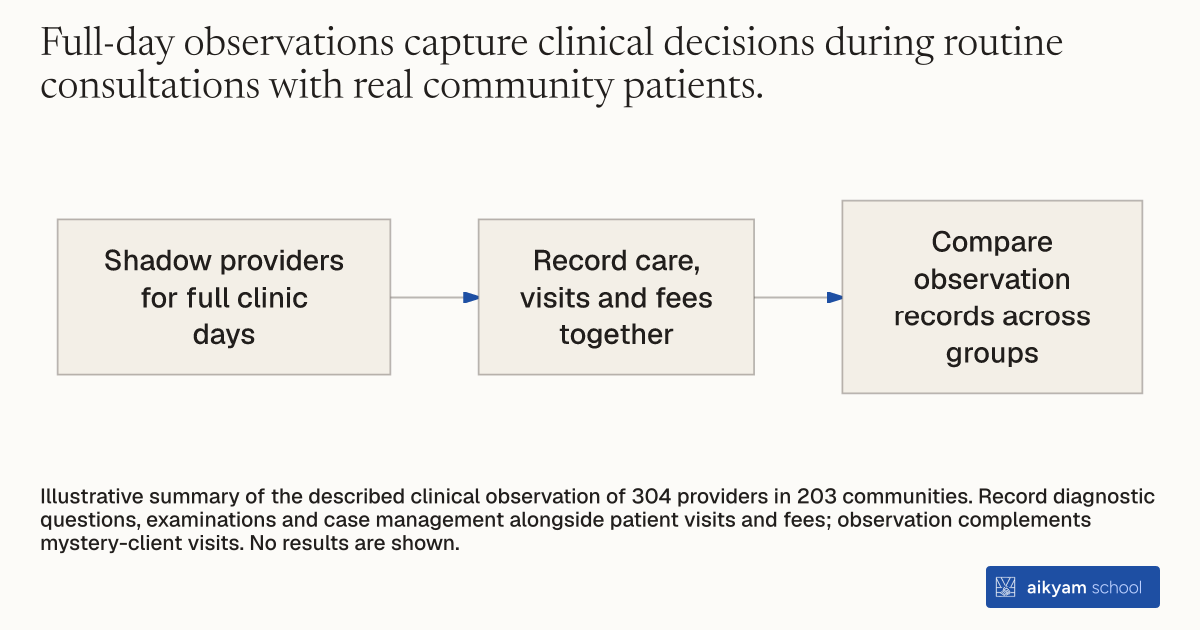
Observe routine clinical care throughout the day
- Shadow providers for full clinic days
- Record care, visits and fees together
- Compare observation records across groups
Illustrative summary of the described clinical observation of 304 providers in 203 communities. Record diagnostic questions, examinations and case management alongside patient visits and fees; observation complements mystery-client visits. No results are shown.
See source →How
When to use
In low-income settings, mystery client assessments evaluate standard simulated illnesses but cannot capture the full range of real patient interactions. Program evaluators need a way to verify provider actions across a diverse real-world case mix. Conducting full-day clinical observations allows researchers to inspect clinical practices, diagnostic actions, and patient volume directly in operating clinics.
Conduct day-long clinical observations at target provider practices to evaluate real-world care delivery across diverse patient visits.
- Assign trained observers to shadow informal healthcare providers in their clinics for full days.
- Observe clinical interactions between providers and a broad sample of real patients throughout the clinic day.
- Record provider diagnostic inquiries, physical examinations, and patient case management practices.
- Document the total number of patient visits and consult fees charged during the observation period.
- Aggregate observation records across treatment and comparison groups to verify care quality and patient demand.
Why it works
This real-world assessment complements standardized mystery client visits by validating overall quality across a broader sample of medical cases.
Example
In West Bengal, India, researchers conducted day-long clinical observations across participating informal healthcare practices. Observational data verified clinical practices for a broader sample of patients while confirming total daily patient visits and fees.
About the study
Participants
304 informal healthcare providers across 203 communities in West Bengal, India.
Study Design
Randomized evaluation incorporating full-day direct clinical observations to complement unannounced mystery client visits across treatment and comparison groups.
Results
Observational data verified clinical quality improvements across real patient encounters while recording an average patient load of 9.2 patients per day for trained providers versus 8.4 for comparison providers.