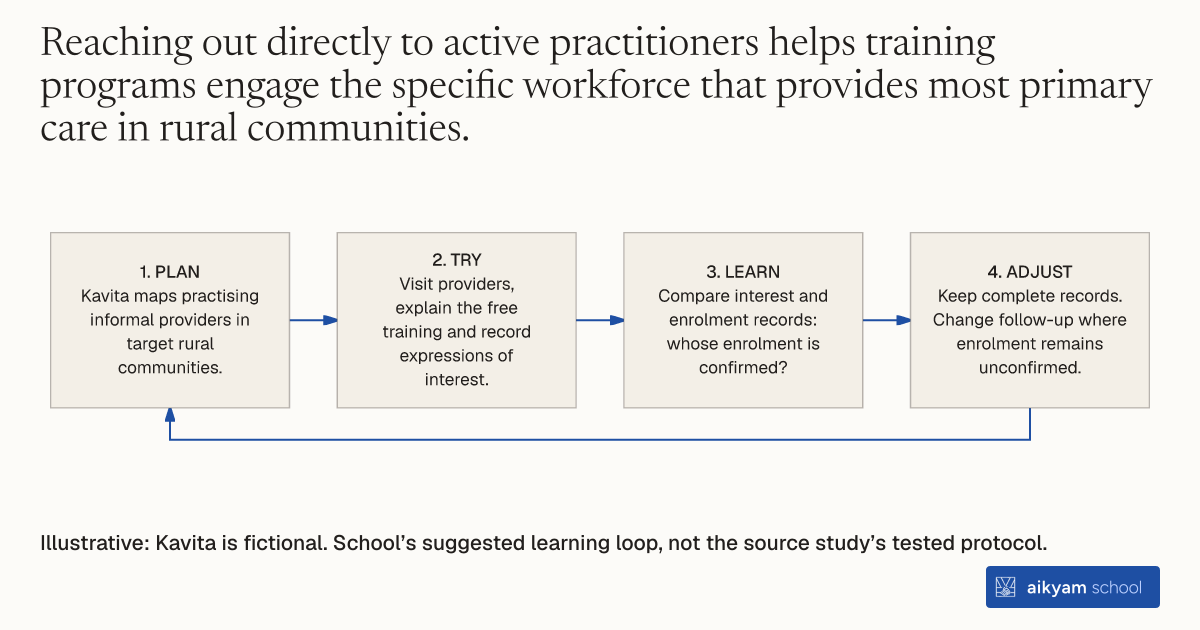
Try, learn and adjust
Check provider interest and enrolment
- Plan: Kavita maps practising informal providers in target rural communities.
- Try: Visit providers, explain the free training and record expressions of interest.
- Learn: Compare interest and enrolment records: whose enrolment is confirmed?
- Adjust: Keep complete records. Change follow-up where enrolment remains unconfirmed.
Illustrative: Kavita is fictional. School’s suggested learning loop, not the source study’s tested protocol.
See source →School’s suggested learning loop: observe interest and enrolment while providers retain daily practices; this loop is separate from random admission.
How
When to use
In many developing countries, informal practitioners without formal medical qualifications provide most primary care in rural communities. Program managers need to identify and engage these informal healthcare workers to offer structured skill training. This method recruits and enrolls practicing informal providers from rural communities into an organized health training initiative.
Identify practicing informal healthcare providers across rural communities and invite them to express interest in a structured training program.
- Map rural communities across target areas to identify informal healthcare practitioners.
- Visit local practitioners in target villages to introduce the health training initiative.
- Invite practicing informal healthcare providers to express interest in attending a free training program.
- Record expressions of interest from eligible informal healthcare providers across target communities.
- Confirm enrollment for interested informal providers while allowing them to maintain active daily clinical practices.
Why it works
Voluntary enrollment ensures that participants are motivated to complete the training course.
Example
In West Bengal, India, researchers and partner organizations identified informal practitioners across 203 communities. A total of 304 informal healthcare providers expressed interest and enrolled in the evaluation.
About the study
Participants
304 informal healthcare providers across 203 communities in West Bengal, India.
Study Design
Randomized evaluation conducted in 203 communities where interested informal providers were enrolled and randomly assigned to treatment or comparison groups.
Results
304 informal healthcare providers expressed interest in participating across 203 study communities in West Bengal.