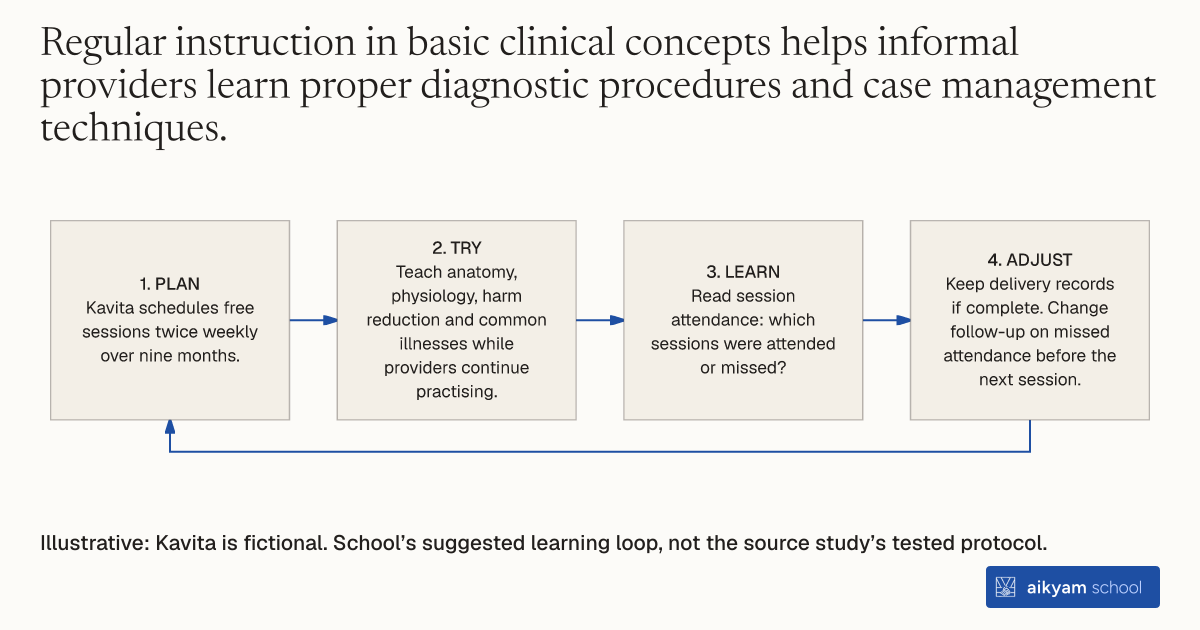
Try, learn and adjust
Check delivery of informal provider training
- Plan: Kavita schedules free sessions twice weekly over nine months.
- Try: Teach anatomy, physiology, harm reduction and common illnesses while providers continue practising.
- Learn: Read session attendance: which sessions were attended or missed?
- Adjust: Keep delivery records if complete. Change follow-up on missed attendance before the next session.
Illustrative: Kavita is fictional. School’s suggested learning loop, not the source study’s tested protocol.
See source →School’s suggested learning loop: observe attendance and curriculum delivery; training confers no doctor qualification or formal completion certificate.
How
When to use
In rural areas of low-income countries, informal health practitioners deliver the majority of primary care despite lacking formal training. This absence of formal education can lead to poor clinical decisions that risk harming patients. Program organizers deliver a structured nine-month training program to teach informal providers basic clinical skills and medical knowledge.
Deliver a free nine-month health training course to practicing informal healthcare providers to improve clinical performance.
- Schedule training sessions twice weekly over a nine-month period.
- Teach foundational lessons on basic human anatomy and physiology.
- Instruct providers on principles of harm reduction, emphasizing the dangers of prescribing unnecessary medicines.
- Train participants on effective identification and management of common illnesses.
- Emphasize that participants are not qualified doctors and issue no formal completion certificates.
- Allow participants to maintain their active medical practices throughout the training period.
Why it works
Emphasizing harm reduction encourages practitioners to avoid dangerous or wasteful medical practices.
Example
In West Bengal, India, 152 informal providers were selected for the nine-month training program, achieving an average attendance rate of 56 percent at each session. Trained providers increased correct case management by 8 percentage points over untrained providers.
About the study
Participants
304 informal healthcare providers across 203 communities in West Bengal, India (152 randomly assigned to training).
Study Design
Randomized evaluation comparing providers admitted to the nine-month training program against a waitlisted control group using unannounced mystery clients and direct clinical observations.
Results
Correct case management reached 60 percent among trained informal providers, an 8 percentage point increase over the comparison group, while checklist completion rose by 4 percentage points to 31 percent.