Research groups
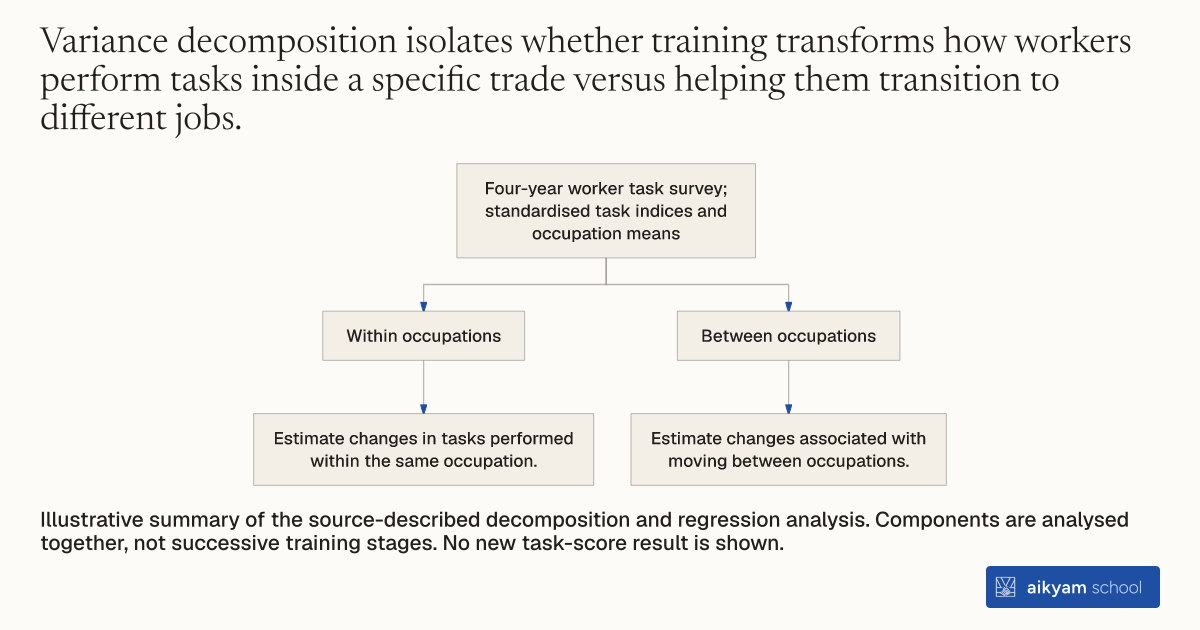
Separate two sources of task change
Four-year worker task survey; standardised task indices and occupation means
- Within occupations
- Estimate changes in tasks performed within the same occupation.
- Between occupations
- Estimate changes associated with moving between occupations.
Illustrative summary of the source-described decomposition and regression analysis. Components are analysed together, not successive training stages. No new task-score result is shown.
See source →How
When to use
Evaluators studying vocational programs often cannot tell whether earnings gains stem from workers entering higher-paying occupations or performing more complex tasks within their existing jobs. Distinguishing between occupational mobility and productivity growth within roles is essential for program design. Decomposing task score changes into within-occupation and between-occupation components isolates the specific mechanism of skill improvement.
Decompose changes in worker task complexity into within-occupation and between-occupation components using standardized task indices.
- Survey workers four years after baseline to measure task frequencies across primary occupations.
- Construct standardized Routine Task Intensity and non-routine analytical task indices for each worker.
- Calculate baseline mean task scores for each specific occupational category across the sample.
- Separate individual task score changes into a between-occupation component driven by occupational shifts and a within-occupation component driven by altered task execution in the same job.
- Estimate treatment effects on both decomposed components using regression analysis to identify the primary driver of skill upgrading.
Why it works
This distinction reveals whether productivity gains reflect deeper technical expertise or broader occupational mobility.
Example
Evaluators in Côte d'Ivoire decomposed task changes among 1,670 youth four years after baseline, finding that 88 percent of the increase in non-routine analytical task score occurred within occupations rather than between occupations.
About the study
Participants
1,670 youth respondents tracked at 4-year endline follow-up (87 percent male, average age 20.7 years) across 7 urban localities in Côte d'Ivoire.
Study Design
Longitudinal randomized trial evaluating worker task complexity score shifts across 2-digit ISCO occupations using variance decomposition.
Results
Dual apprenticeship increased non-routine analytical task scores by 0.243 standard deviations (p < 0.0001), with 88 percent of this increase driven by within-occupation task shifts and 12 percent by between-occupation movements.