Research steps
Build a routine task intensity index
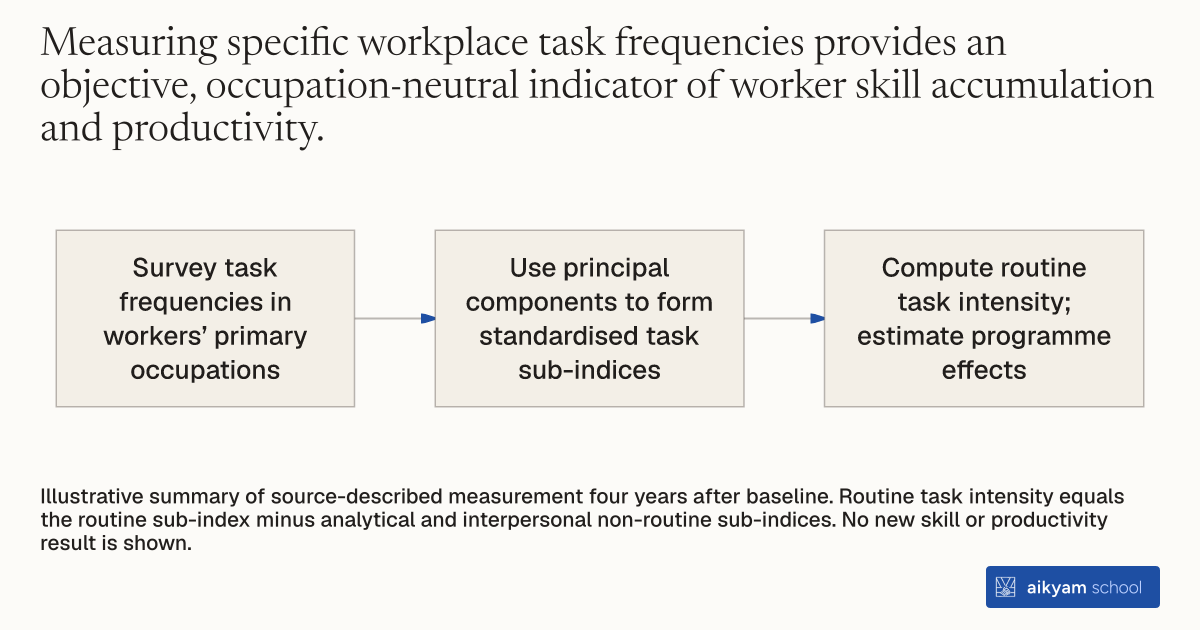
- Survey task frequencies in workers’ primary occupations
- Use principal components to form standardised task sub-indices
- Compute routine task intensity; estimate programme effects
Illustrative summary of source-described measurement four years after baseline. Routine task intensity equals the routine sub-index minus analytical and interpersonal non-routine sub-indices. No new skill or productivity result is shown.
See source →How
When to use
Evaluating skill acquisition in informal labor markets is difficult because job titles and formal schooling rarely reflect real productivity changes. Public programs need an objective method to determine whether vocational training upgrades worker capabilities. Constructing a standardized Routine Task Intensity index measures shifts in daily worker duties from routine physical execution toward complex non-routine analytical tasks.
Measure worker skill shifts using a standardized Routine Task Intensity index constructed from worker task frequencies.
- Administer a task-content survey module to workers in their primary occupation, collecting self-reported frequencies across routine cognitive, routine manual, non-routine analytical, and non-routine interpersonal tasks.
- Conduct principal component analysis on task frequency items to construct standardized sub-indices for routine tasks, non-routine analytical tasks, and non-routine interpersonal tasks.
- Compute the overall Routine Task Intensity index by adding the routine sub-index and subtracting the non-routine analytical and non-routine interpersonal sub-indices.
- Estimate program impact on normalized Routine Task Intensity indices using regression analysis to evaluate worker skill acquisition and task complexity shifts.
Why it works
Aggregating tasks into a single index captures whether trainees transition from basic manual execution to complex analytical thinking and problem-solving.
Example
Evaluators in Côte d'Ivoire administered a task-content survey to 1,670 youth four years after baseline, constructing a Routine Task Intensity index that showed dual apprentices increased non-routine analytical task performance by 0.243 standard deviations and decreased overall routine task intensity by 0.213 standard deviations.
About the study
Participants
1,670 youth respondents tracked at 4-year endline follow-up (87 percent male, average age 20.7 years) across 7 urban localities in Côte d'Ivoire.
Study Design
Randomized controlled trial measuring worker-level task complexity and Routine Task Intensity index changes across primary occupations 4 years after baseline.
Results
Dual apprenticeship increased non-routine analytical task involvement by 0.243 standard deviations (p < 0.0001) and non-routine interpersonal tasks by 0.079 standard deviations (p = 0.080), reducing the overall Routine Task Intensity index by 0.213 standard deviations (p = 0.008).