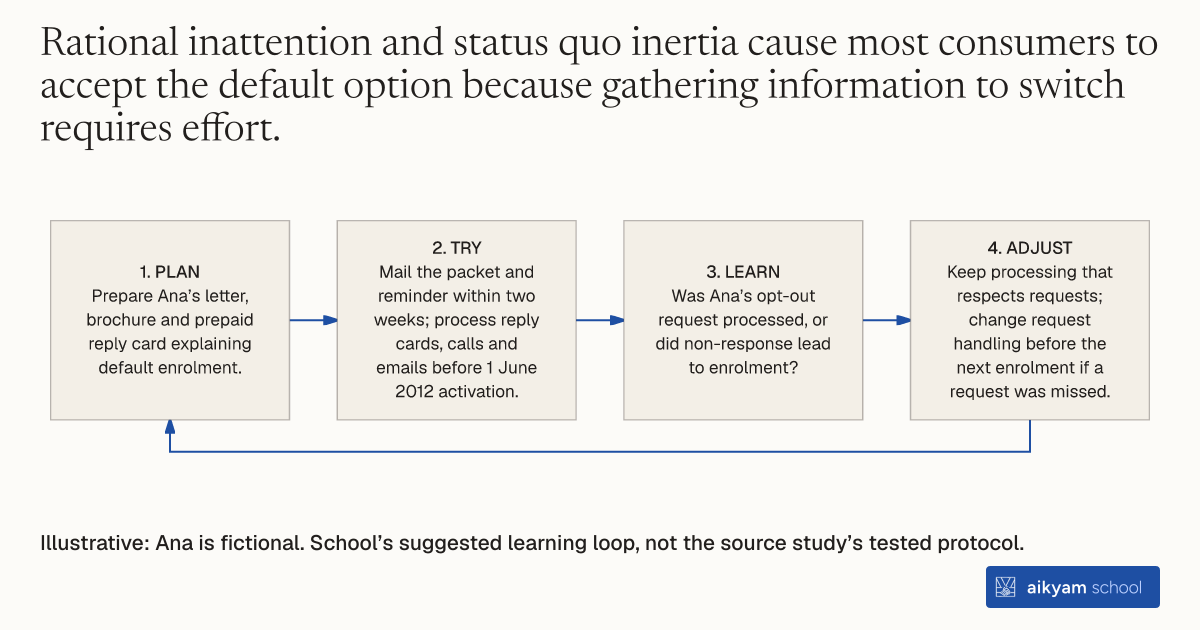
Try, learn and adjust
Check default enrolment preserves opt-out choice
- Plan: Prepare Ana’s letter, brochure and prepaid reply card explaining default enrolment.
- Try: Mail the packet and reminder within two weeks; process reply cards, calls and emails before 1 June 2012 activation.
- Learn: Was Ana’s opt-out request processed, or did non-response lead to enrolment?
- Adjust: Keep processing that respects requests; change request handling before the next enrolment if a request was missed.
Illustrative: Ana is fictional. School’s suggested learning loop, not the source study’s tested protocol.
See source →School’s suggested learning loop, not a tested source procedure. Observe packet delivery, opt-out requests and account status; opt-out channels remain open indefinitely.
How
When to use
Public utilities and energy administrators need to enroll large portions of residential customers into time-varying pricing rates. Standard opt-in enrollment leads to low participation and missed efficiency gains. Default opt-out notification automatically assigns customers to new rate structures while providing clear, low-friction avenues to decline.
Notify eligible utility customers of their automatic enrollment in a new pricing tariff while offering them an explicit option to opt out.
- Program administrators prepare information packets containing a letter, brochure, and postage-paid business reply card designed similarly to opt-in recruitment materials.
- Program administrators mail out default enrollment packets to 10 percent of targeted households on March 12, 2012 and the remaining 90 percent on April 5, 2012.
- Program administrators send a follow-up reminder postcard to all defaulted households within two weeks of their initial packet mailing.
- Program staff receive and process returned business reply cards, phone calls, or emails from households choosing to opt out prior to the June 1, 2012 rate activation date.
- Program administrators transition non-responding households onto the new time-varying rate on June 1, 2012 while leaving opt-out channels open indefinitely.
Why it works
Additionally, consumers view the utility provider's default assignment as an authoritative recommendation.
Example
SMUD notified 846 CPP households and 2,407 TOU households in Sacramento, California of default enrollment in early spring 2012. Fewer than 5 percent actively opted out prior to the June 1 start date, securing over 95 percent initial participation.
About the study
Participants
3,253 residential households (846 CPP opt-out and 2,407 TOU opt-out) in Sacramento, California.
Study Design
Randomized controlled trial assigning eligible households to default opt-out encouragement with the option to leave at any time.
Results
Fewer than 5 percent of defaulted customers opted out initially, leaving 96.0 percent of CPP households and 97.9 percent of TOU households enrolled at the start of the program on June 1, 2012.