Research procedure
Calibrate beliefs and returns on attention
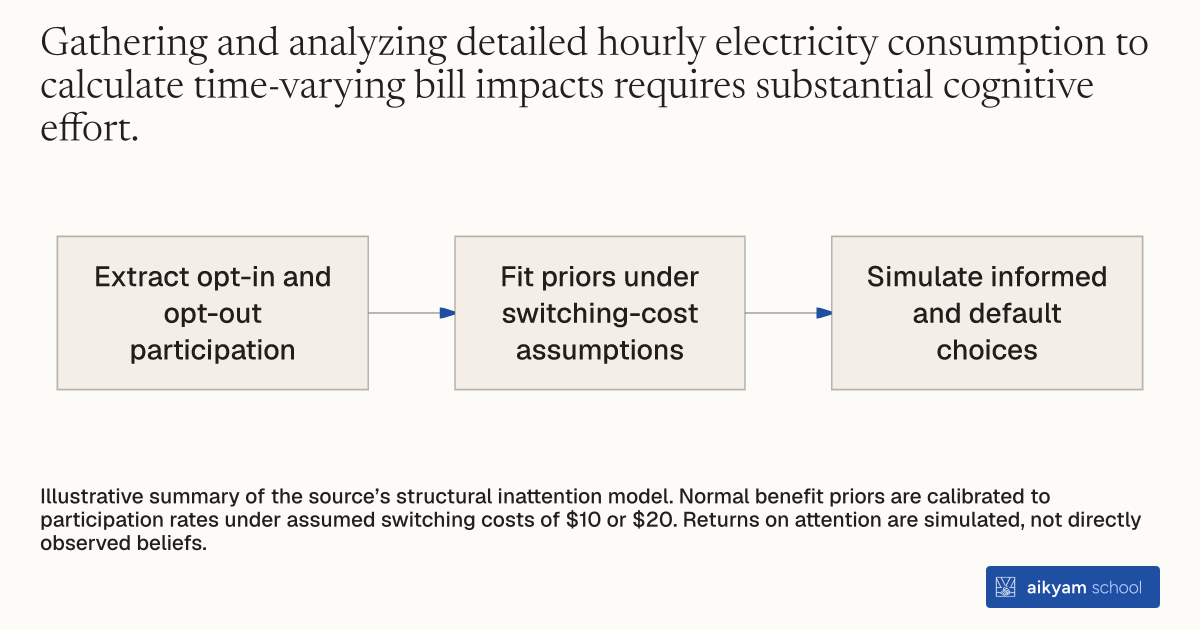
- Extract opt-in and opt-out participation
- Fit priors under switching-cost assumptions
- Simulate informed and default choices
Illustrative summary of the source’s structural inattention model. Normal benefit priors are calibrated to participation rates under assumed switching costs of $10 or $20. Returns on attention are simulated, not directly observed beliefs.
See source →How
When to use
Economists and policy evaluators need to explain why default nudges alter participation despite negligible switching costs. Standard utility models predict participation aligns with expected financial gains, yet real-world choices show virtually no correlation with net savings. Structural inattention modeling calibrates consumer prior beliefs and information costs to determine whether ignoring initial default decisions is rational.
Calibrate a two-step structural inattention model using observed program participation rates to estimate consumer prior beliefs and information gathering returns.
- Analysts extract participation rates across opt-in and opt-out experimental groups to establish baseline choice shares under default manipulations.
- Analysts specify a normal distribution of uninformed benefit priors with a mean and standard deviation independent of actual structural gains.
- Analysts fix an assumed switching cost parameter such as 10 dollars or 20 dollars to represent basic administrative effort.
- Analysts solve two identifying conditions matching predicted participation probabilities under uninformed priors to observed opt-in and opt-out participation rates.
- Analysts simulate consumer returns on attention by calculating the net bill difference between informed re-optimized choices and uninformed default choices across discount heuristics.
Why it works
When information collection costs exceed the modest annual bill savings from switching tariffs, remaining inattentive to default assignment is economically rational.
Example
Researchers modeled rational inattention across 174,000 utility households in Sacramento, California, showing that with a 10 dollar switching cost, the calibrated mean benefit prior was 3.53 dollars with a standard deviation of 7.73 dollars, and average two-year returns on attention ranged from 3.76 dollars to 13.51 dollars for opt-out consumers.
About the study
Participants
174,000 residential utility households evaluated in Sacramento, California.
Study Design
Structural choice simulation calibrating a normal distribution of uninformed prior beliefs against observed opt-in and opt-out participation rates under 10 dollar and 20 dollar switching cost assumptions.
Results
Assuming a 10 dollar switching cost, uninformed benefit priors averaged 3.53 dollars with a standard deviation of 7.73 dollars, yielding low average returns on attention ranging between 3 dollars and 14 dollars over two years under the no-adjustment heuristic.