Try, learn and adjust
Check recruiter visits provide job information
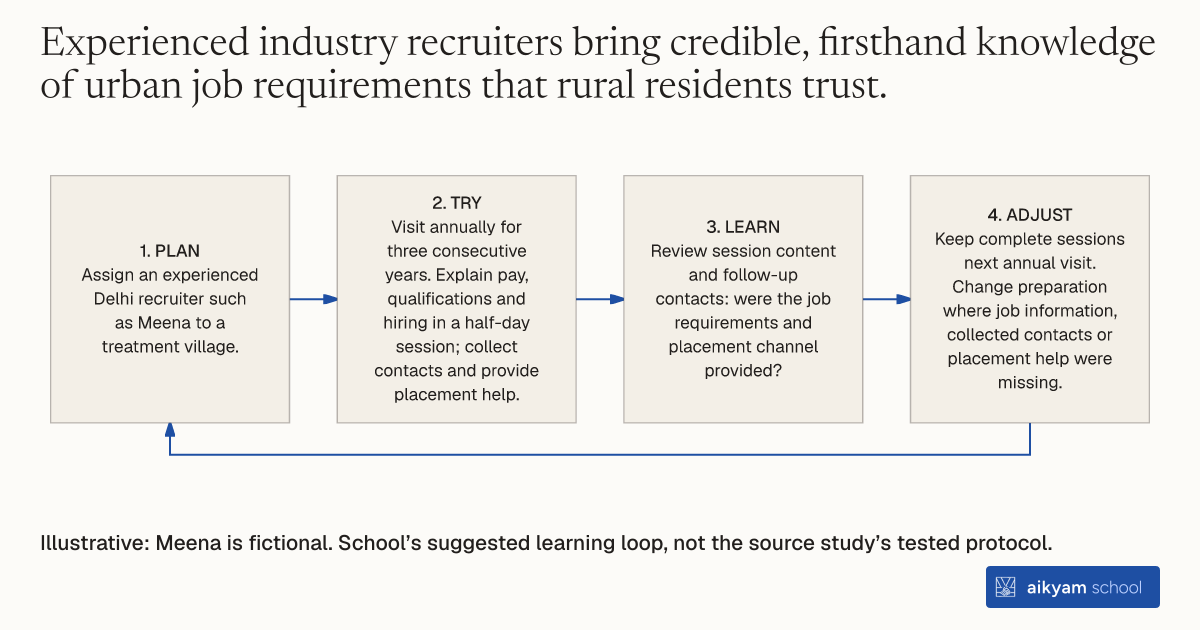
- Plan: Assign an experienced Delhi recruiter such as Meena to a treatment village.
- Try: Visit annually for three consecutive years. Explain pay, qualifications and hiring in a half-day session; collect contacts and provide placement help.
- Learn: Review session content and follow-up contacts: were the job requirements and placement channel provided?
- Adjust: Keep complete sessions next annual visit. Change preparation where job information, collected contacts or placement help were missing.
Illustrative: Meena is fictional. School’s suggested learning loop, not the source study’s tested protocol.
See source →School’s suggested, untested loop. Observe visits, job information and placement contacts. Recruiters have at least two years of experience; this check does not establish employment effects.
How
When to use
In rural areas, local populations lack connection to urban industries and specialized hiring networks. This method connects remote communities directly with experienced urban job recruiters. It helps rural job seekers gain credible labor market guidance from industry professionals.
Deploy experienced urban recruiters to conduct targeted outreach in rural villages.
- Program managers hire eight business process outsourcing recruiters from Delhi, each having at least two years of recruitment experience.
- Managers assign one recruiter randomly to each designated treatment village located 50 to 150 km from Delhi.
- Recruiters visit assigned rural villages once per year for three consecutive years from 2003 to 2006.
- Recruiters deliver half-day information sessions covering salary levels, job qualifications, and hiring procedures.
- Recruiters collect contact information and provide follow-up placement assistance to qualified candidates.
Why it works
Their established industry networks enable direct connections between qualified rural candidates and urban employers.
Example
Eight recruiters from Delhi with at least two years of experience visited 80 rural villages across Haryana, Punjab, Rajasthan, and Uttar Pradesh. Over three years, BPO employment among young women aged 18 to 24 increased by 4.6 percentage points in visited villages compared to comparison villages.
About the study
Participants
160 rural villages (80 treatment, 80 comparison) and 3,200 households across Haryana, Punjab, Rajasthan, and Uttar Pradesh, India.
Study Design
Cluster randomized controlled trial assigning one experienced Delhi BPO recruiter per treatment village for annual visits from 2003 to 2006.
Results
BPO employment among women aged 18 to 24 increased by 4.6 percentage points, and paid employment outside the home increased by 2.4 percentage points.