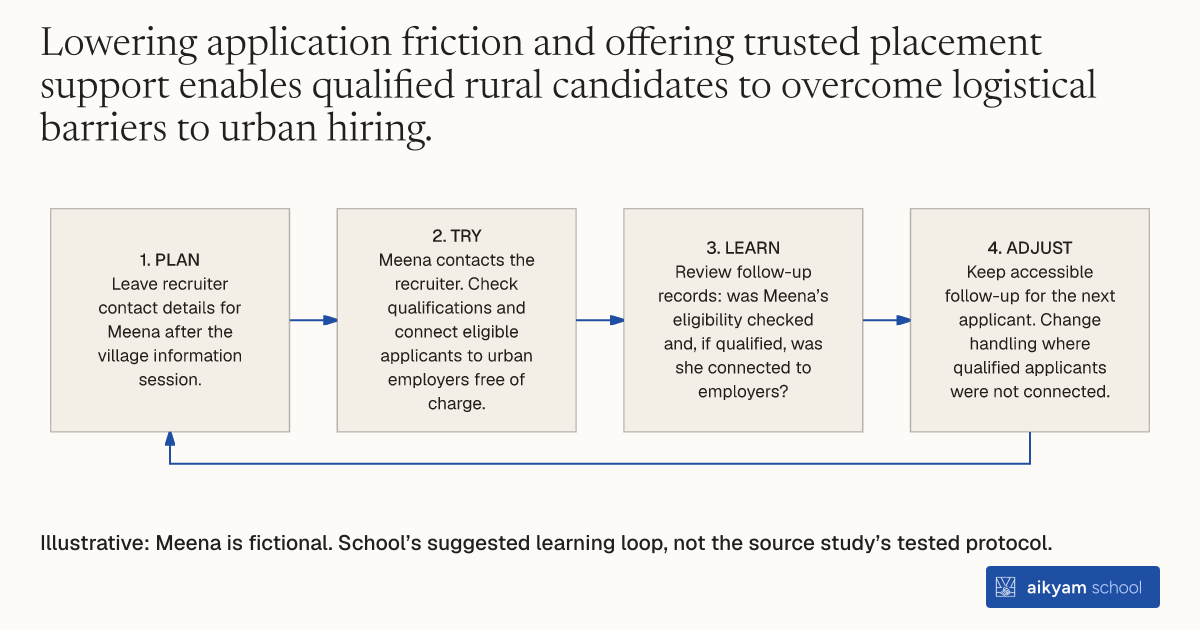
Try, learn and adjust
Check applicants reach free placement support
- Plan: Leave recruiter contact details for Meena after the village information session.
- Try: Meena contacts the recruiter. Check qualifications and connect eligible applicants to urban employers free of charge.
- Learn: Review follow-up records: was Meena’s eligibility checked and, if qualified, was she connected to employers?
- Adjust: Keep accessible follow-up for the next applicant. Change handling where qualified applicants were not connected.
Illustrative: Meena is fictional. School’s suggested learning loop, not the source study’s tested protocol.
See source →School’s suggested, untested loop. Observe applicant-initiated contact, qualification checks and employer connections. A connection is not a job offer.
How
When to use
In remote rural areas, qualified female job seekers face search friction and lack direct connections to urban employers. This method provides direct contact channels and recruitment support for women seeking formal sector employment. It helps educated young rural women transition from awareness to active job placement.
Provide direct placement support and contact channels to qualified candidates who initiate follow-ups after recruitment drives.
- Experienced urban recruiters leave their contact details at rural information sessions.
- Recruiters agree to assist qualified female candidates free of charge.
- Interested female applicants proactively contact the recruiters.
- Recruiters screen candidate qualifications against entry-level job criteria.
- Recruiters connect qualified applicants directly to urban BPO employers for hiring.
Why it works
Direct recruiter access converts initial job interest into verified employment.
Example
In 80 rural villages in North India, recruiters provided contact details and placement support to qualified female candidates who reached out. Over three years, BPO employment among women aged 18 to 24 increased by 4.6 percentage points, even though only 28 percent of women had the required schooling.
About the study
Participants
160 rural villages (80 treatment, 80 comparison) and 3,200 households across Haryana, Punjab, Rajasthan, and Uttar Pradesh, India.
Study Design
Cluster randomized controlled trial with three annual recruiter visits offering contact info and free placement assistance from 2003 to 2006.
Results
BPO sector employment for women aged 18 to 24 increased by 4.6 percentage points, and paid work outside the home rose by 2.4 percentage points.