Try, learn and adjust
Check yarn records against storage locations
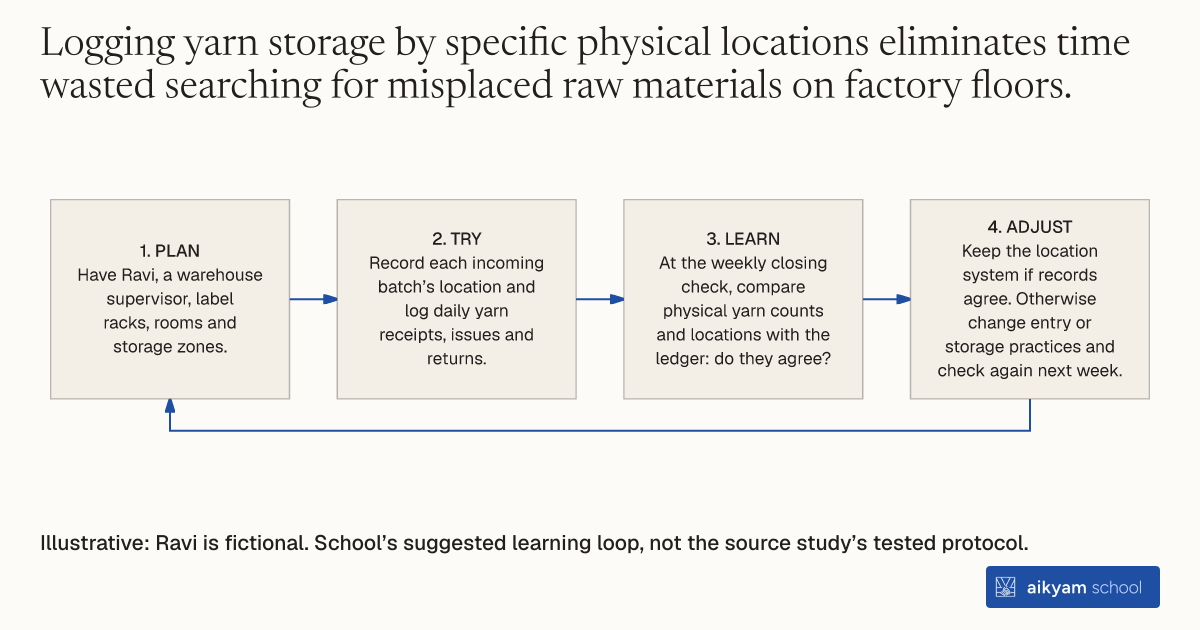
- Plan: Have Ravi, a warehouse supervisor, label racks, rooms and storage zones.
- Try: Record each incoming batch’s location and log daily yarn receipts, issues and returns.
- Learn: At the weekly closing check, compare physical yarn counts and locations with the ledger: do they agree?
- Adjust: Keep the location system if records agree. Otherwise change entry or storage practices and check again next week.
Illustrative: Ravi is fictional. School’s suggested learning loop, not the source study’s tested protocol.
See source →School’s suggested, untested loop: observe batch locations, transaction logs and weekly physical stock checks.
How
When to use
Manufacturing plants often store raw yarn packages across multiple warehouse zones without logging specific shelf or room locations. This method establishes location-wise stock entry tracking and daily transaction logging for raw yarn storage. It helps inventory managers and warehouse supervisors prevent material misplacement, speed up order fulfillment, and maintain accurate raw stock balances.
Implement a location-wise yarn inventory tracking system to record raw material receipts, storage locations, and daily stock issues.
- Assign distinct physical labels, codes, and demarcated zone designations to all yarn storage racks and warehouse rooms.
- Warehouse clerks record the exact physical location of every incoming yarn batch upon receipt.
- Inventory staff maintain daily transaction logs recording yarn receipts, issues to weaving sheds, and stock returns.
- Storekeepers log location-wise inventory entries on standardized paper tracking ledgers or computer software.
- Warehouse supervisors conduct weekly closing stock checks to verify physical yarn counts against logged storage locations.
Why it works
Systematic location tracking ensures raw yarn is easily traceable, properly rotated, and issued promptly to active loom orders.
Example
In 2008, international consultants introduced location-wise yarn storage entry tracking across experimental textile plants near Mumbai, India. Adoption of location-wise yarn tracking grew from 28% of plants in 2008 to 61% in 2011 and 50% in 2017, with zero adopting plants dropping the practice over nine years.
About the study
Participants
28 manufacturing plants across 17 family-owned cotton weaving firms near Mumbai, India, averaging 270 employees, \$8.5 million in assets, and \$7.5 million in annual sales.
Study Design
Randomized Controlled Trial (RCT) tracking 38 management practices across treatment and control plants from 2008 to 2017.
Results
Location-wise yarn entry logging increased from 28% adoption in 2008 to 61% in 2011 and remained at 50% in 2017, with 7 plants adopting and 0 plants dropping the practice between 2008 and 2017.