Research procedure
Protect aggregate mobility records
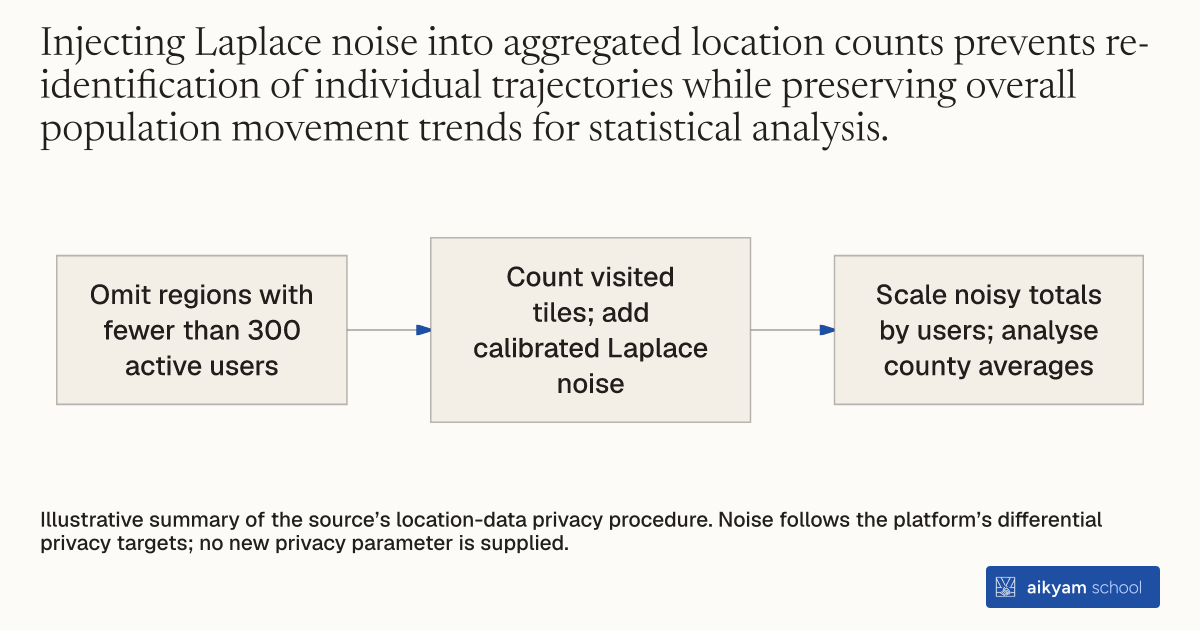
- Omit regions with fewer than 300 active users
- Count visited tiles; add calibrated Laplace noise
- Scale noisy totals by users; analyse county averages
Illustrative summary of the source’s location-data privacy procedure. Noise follows the platform’s differential privacy targets; no new privacy parameter is supplied.
See source →How
When to use
Public health evaluations rely on mobile phone location tracking to observe population mobility trends during disease outbreaks. Publishing aggregate location records risks exposing individual movements and compromising user privacy. Adding mathematical differential privacy noise allows organizations to release public mobility metrics while safeguarding individual participant data.
Apply mathematical noise perturbation to aggregated mobile location metrics prior to public data release.
- Mobility tracking systems omit all geographic regions containing fewer than 300 active users on a given date.
- Analytics software counts total Bing level-16 tile visits made by opted-in users in each county.
- System algorithms introduce random mathematical noise following a Laplace distribution calibrated to target differential privacy thresholds.
- Programmers scale noisy total tile counts by the total observed user population to yield anonymized daily county averages.
- Econometricians analyze noise-adjusted county mobility indicators to evaluate aggregate population travel without accessing individual location records.
Example
Facebook applied differential privacy algorithms to county mobility data covering Facebook users in 820 US counties during the Thanksgiving and Christmas campaigns.
About the study
Participants
Facebook users across 696 counties at Thanksgiving and 677 counties at Christmas in 13 US states.
Study Design
OLS regressions on daily aggregated Facebook Movement Range metrics subjected to Laplace differential privacy noise.
Results
County travel distance in the 3 days before holidays dropped by 0.993 percentage points (P = 0.002) in high-intensity relative to low-intensity counties.