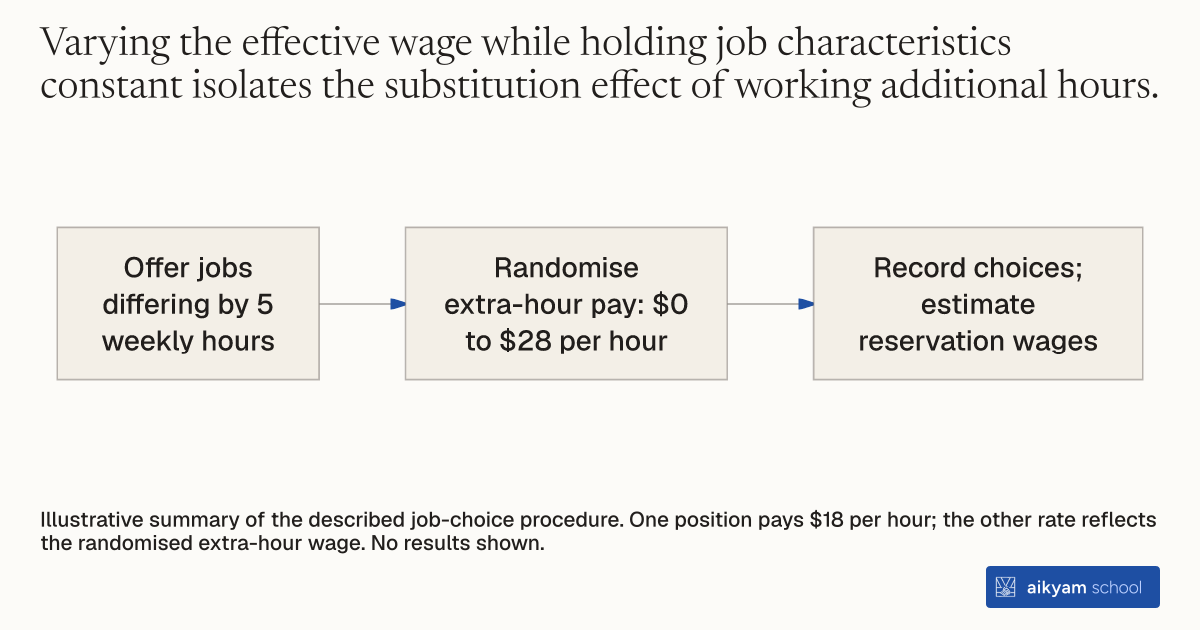
Research steps
Compare job choices
- Offer jobs differing by 5 weekly hours
- Randomise extra-hour pay: $0 to $28 per hour
- Record choices; estimate reservation wages
Illustrative summary of the described job-choice procedure. One position pays $18 per hour; the other rate reflects the randomised extra-hour wage. No results shown.
See source →How
When to use
Organizations or researchers need to measure how workers value extra work hours without confounding income effects or job quality. Traditional job offers combine fixed schedules and fixed pay rates, making individual leisure valuation difficult to observe. Presenting randomized wage-hour bundles in real job applications allows employers to isolate worker willingness to supply marginal labor.
Offer job applicants discrete choices between two job options with different weekly hours and randomized wages to measure labor supply responsiveness.
- Post temporary work-from-home position listings without specifying hours or wages.
- Assign each applicant a choice between a shorter job bundle of X hours and a longer job bundle of X+5 hours, where X ranges from 5 to 35 hours per week.
- Randomly vary the effective wage for the final five hours between \$0 and \$28 per hour.
- Set the wage of one position at \$18 per hour while setting the wage of the second position using the randomized effective wage formula.
- Display both job descriptions side-by-side on an application portal and require applicants to select their preferred position.
- Record applicant job choices to estimate reservation wages across different work hour levels.
Why it works
Eliminating income effects ensures applicant choices reflect their true marginal value of time across different schedule lengths.
Example
Researchers offered 1,152 unemployed applicants across 80 U.S. metro areas choices between pairs of remote phone survey or data entry jobs differing by 5 weekly hours with effective wages ranging from \$0 to \$28. At lower hours like 5 versus 10, applicants accepted longer hours at a mean effective wage of \$4.80, whereas for 40 versus 45 hours, applicants required a mean effective wage of \$21.89.
About the study
Participants
N = 1,152 unemployed applicants (83% female, average age 32.7 years, 44% White, 34% Black, 12% Hispanic) across 80 U.S. metropolitan areas.
Study Design
Randomized field experiment presenting job seekers with discrete choices between two remote job options differing by 5 weekly hours and randomized effective wages, analyzed with a logit choice model.
Results
The mean estimated marginal value of time increases monotonically from \$4.80 per hour for 5 to 10 hours per week, to \$8.95 for 20 to 25 hours per week, \$12.00 to \$14.68 for 30 to 40 hours per week, and \$21.89 for 40 to 45 hours per week.