Research steps
Price extra work hours
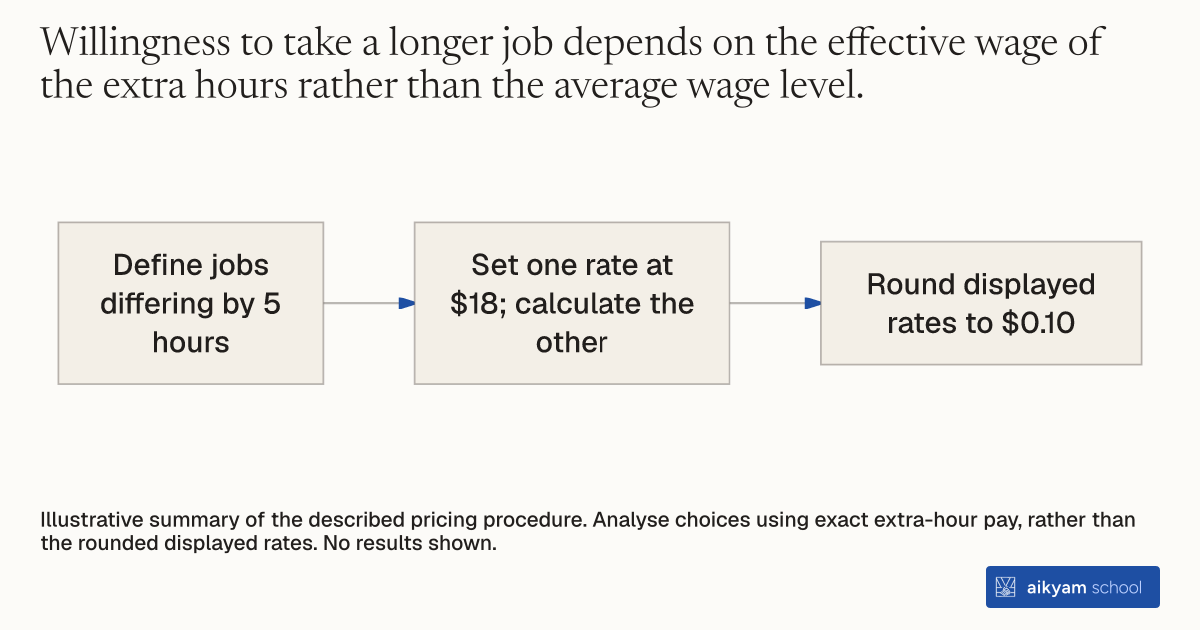
- Define jobs differing by 5 hours
- Set one rate at $18; calculate the other
- Round displayed rates to $0.10
Illustrative summary of the described pricing procedure. Analyse choices using exact extra-hour pay, rather than the rounded displayed rates. No results shown.
See source →How
When to use
Employers and researchers must price discrete job choices that differ in schedule length without distorting worker incentives. Standard wage offers change average hourly pay, which confounds total income effects with the compensation for extra hours. This method helps job designers and labor economists isolate how workers value incremental work time.
Set job hourly wages based on a target effective incremental wage formula to price additional work hours cleanly.
- Define a baseline work-hour bundle and an extended work-hour bundle differing by five hours.
- Select a target effective hourly wage representing the incremental earnings for each extra hour worked.
- Calculate earnings for the extended job using the effective wage differential formula.
- Set the hourly wage of one position at a baseline rate of eighteen dollars per hour.
- Compute the required hourly wage for the second position so the differential equals the target effective wage.
- Present both hourly rates rounded to the nearest ten cents while evaluating choices using the exact effective wage.
Why it works
This isolates the substitution effect and measures the pure value of lost leisure.
Example
Researchers offered 2,658 applicants in 80 U.S. cities job choices such as 25 versus 30 hours per week. For a target effective wage of zero dollars, the 25-hour job paid eighteen dollars per hour and the 30-hour job paid fifteen dollars per hour, resulting in identical total earnings of 450 dollars.
About the study
Participants
N = 2,658 applicants (83% female, average age 33.6 years) across 80 U.S. metropolitan areas.
Study Design
Randomized field experiment where effective incremental wages ranging from 0 to 28 dollars per hour were assigned across 5-hour schedule increases and evaluated with a logit model.
Results
Effective wage pricing isolated leisure valuation across schedule lengths, showing unemployed workers value full-time non-work time at 0.58 of their predicted pre-tax market wage.