Research design
Compare two wage displays
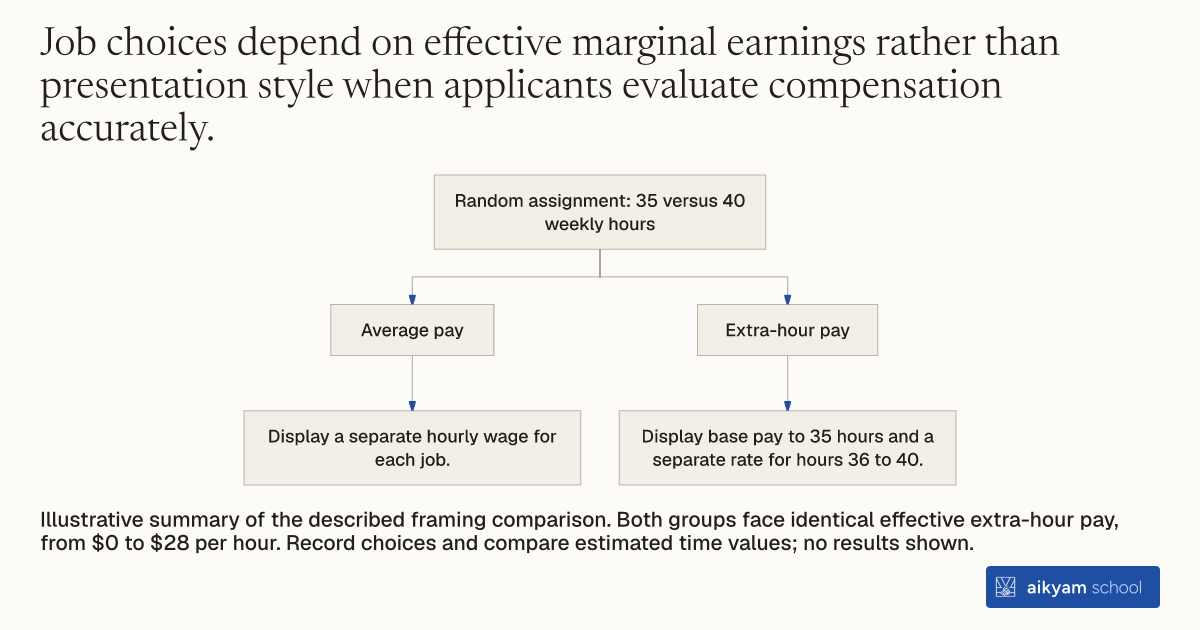
Random assignment: 35 versus 40 weekly hours
- Average pay
- Display a separate hourly wage for each job.
- Extra-hour pay
- Display base pay to 35 hours and a separate rate for hours 36 to 40.
Illustrative summary of the described framing comparison. Both groups face identical effective extra-hour pay, from $0 to $28 per hour. Record choices and compare estimated time values; no results shown.
See source →How
When to use
Researchers and job designers must test whether job applicants make different choices when wages appear as average hourly pay rather than explicit incremental pay. Standard job offers present total average pay, which might confuse applicants who fail to calculate marginal earnings correctly. Comparing average wage framing against explicit marginal wage framing verifies that presentation format does not distort measured labor choices.
Compare candidate decisions across job options using separate average wages versus explicit marginal rates to test choice framing invariance.
- Divide applicants randomly into a traditional framing group and an overtime framing group for a 35 versus 40 hours per week job choice.
- Present the traditional group with two position options displaying two separate average hourly pay rates.
- Present the overtime framing group with two position options sharing the same base wage up to 35 hours and displaying a separate rate for hours 36 through 40.
- Set identical effective hourly wages for the final five hours across both framing groups.
- Record applicant selections between the 35-hour and 40-hour positions across effective wage levels ranging from 0 to 28 dollars per hour on the application portal.
- Estimate and compare the marginal value of time between the two framing groups using a logit choice model.
Why it works
Showing that both framings yield similar time values proves that cognitive framing biases do not distort labor supply estimates.
Example
Researchers offered 272 job applicants in 80 U.S. metro areas a 35 versus 40 hours per week choice phrased as either two separate hourly wages or one base wage with a separate rate for hours 36 to 40. Applicants chose the 40-hour job at similar rates across both framings, showing that framing does not alter time valuation.
About the study
Participants
N = 272 applicants across 80 U.S. metropolitan areas in a 35 vs 40 hours per week job comparison treatment.
Study Design
Randomized field experiment offering job seekers a choice between 35 and 40 weekly hours phrased as two separate hourly wages or a base wage with a marginal rate for the final 5 hours.
Results
Estimated marginal values of time for 35 versus 40 hours (\$12.00, s.e. = 1.50) are close across both framings, confirming that choice framing does not influence time valuation.