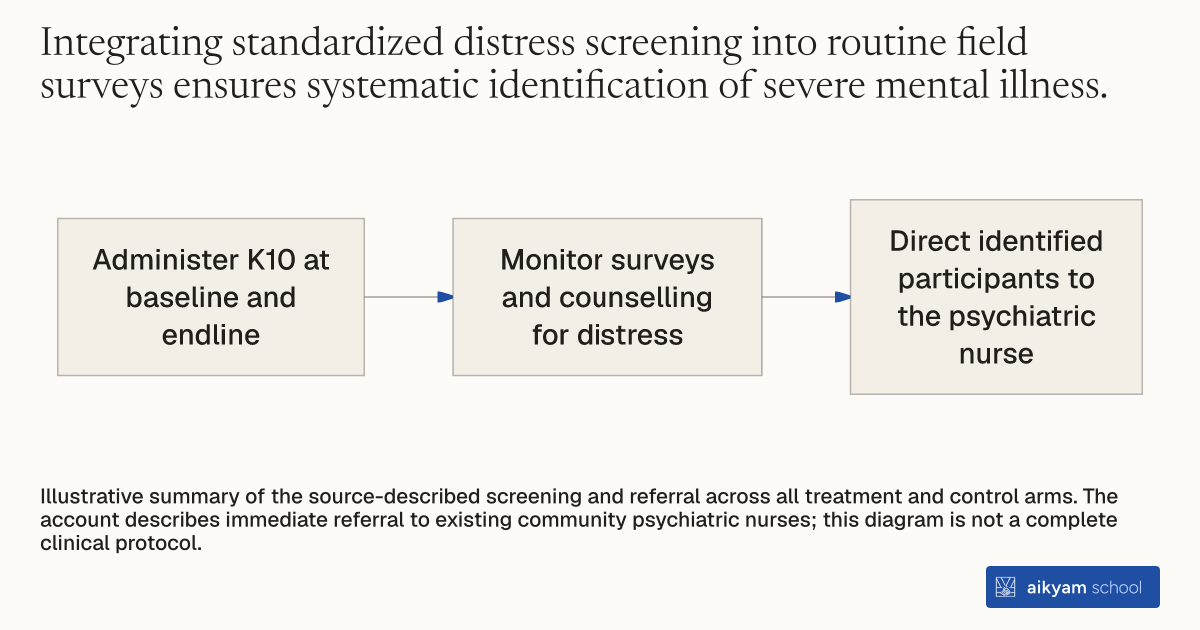
Research steps
Refer distress identified during research
- Administer K10 at baseline and endline
- Monitor surveys and counselling for distress
- Direct identified participants to the psychiatric nurse
Illustrative summary of the source-described screening and referral across all treatment and control arms. The account describes immediate referral to existing community psychiatric nurses; this diagram is not a complete clinical protocol.
See source →How
When to use
In low-resource community trials, field research and group therapy sessions can uncover individuals suffering from severe psychological distress or mental health crises. Organizations need an ethical protocol to screen participants and provide professional care connections without compromising study design or participant safety. This method connects distressed community members to public psychiatric care during large-scale research projects.
Screen study participants for psychological distress during surveys and immediately refer identified individuals to local health system specialists.
- Administer the Kessler Psychological Distress Scale (K10) to all community participants during baseline and endline household surveys.
- Monitor survey responses in real time for indications of severe psychological distress or acute mental health crises.
- Identify any participant exhibiting severe distress during survey administration or group counseling sessions.
- Provide immediate referral instructions to direct the distressed individual to the local community psychiatric nurse for clinical care.
- Apply referral protocols uniformly across all study participants regardless of whether they are randomized into treatment or control arms.
Why it works
Immediate direct referrals to existing community psychiatric nurses provide ethical clinical support without creating parallel healthcare infrastructure.
Example
Innovations for Poverty Action administered K10 distress screenings during surveys of 7,445 rural adults in Ghana, referring any respondent identified with severe distress directly to their district's community psychiatric nurse.
About the study
Participants
7,445 adults surveyed across 258 rural communities in 14 districts in Ghana.
Study Design
Universal distress screening integrated into randomized controlled trial baseline and endline surveys, with standardized psychiatric nurse referral protocols applied across all arms.
Results
Identified baseline psychological distress in 55% of respondents and severe distress in 15%, ensuring universal referral access to district psychiatric nurses while maintaining ethical equipoise.